
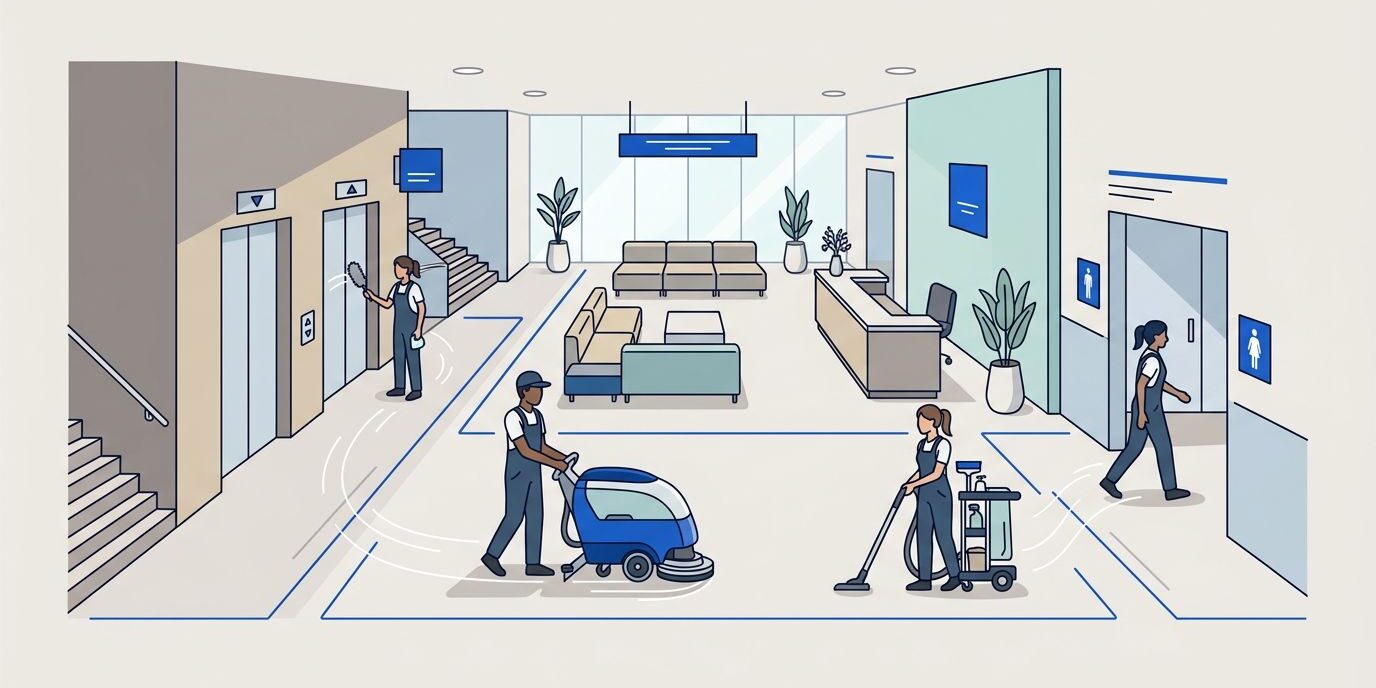
A single-tenant office is one conversation. A multi-tenant building is ten, twenty, or sometimes fifty conversations happening at once regarding commercial cleaning.
That is why multi-tenant office cleaning needs a real plan, not a generic nightly checklist. If your lobbies look good but shared restrooms fall apart by lunch, tenants notice. If one suite gets over-serviced while another keeps calling with complaints, you feel it fast.
The fix is not more cleaning across the board. It is smarter planning, tighter scope, and a schedule built around how office buildings are actually used to ensure effective facility management.
Key Takeaways
- Prioritize High-Traffic Zones: Instead of a blanket cleaning schedule, focus resources on shared spaces like lobbies, restrooms, and elevators where usage dictates the most frequent maintenance.
- Map the Building by Usage: Break the property into specific zones—public, semi-private, and tenant-only—to tailor cleaning frequencies to the actual wear and tear of each area.
- Standardize Communications: Eliminate vague complaints by establishing clear points of contact, using inspection logs, and defining exactly what services are included in the scope for both management and tenants.
- Protect Your Assets: View cleaning as a form of long-term property maintenance that prevents premature wear on flooring, glass, and surfaces, rather than just a cosmetic service.
- Prepare for Variability: Build contingency plans for non-routine events like move-ins, seasonal weather changes, or large tenant meetings to ensure the building maintains standards during busy periods.
Why shared office buildings need a different cleaning plan
A multi-tenant office building does not behave like a single office with a bigger footprint. It behaves like a small neighborhood under one roof, requiring specialized janitorial services to keep office buildings functioning at their best.
Each tenant has different hours, different standards, and different pain points. A law office may want silent after-hours service. A call center may need daytime touch-ups because traffic never really stops. A professional services suite may look tidy all day, while the high-traffic areas like the break room on the first floor get hammered by 10 a.m.
The biggest trouble spots are usually the common areas that no one tenant controls. Lobbies, elevators, corridors, shared restrooms, kitchens, conference rooms, and entryways take the daily beating. These are also the places tenants use to judge the overall level of tenant satisfaction. They do not separate their private suite from building management in their minds. Dirty grout, smudged glass, full trash, or restroom odors all land in the same bucket: poor building care.
That is why a commercial cleaning plan has to do more than list tasks. It has to assign frequency, timing, ownership, and response standards. Who checks the restroom sanitation after a morning rush? Who restocks paper goods in shared pantries? Who handles spills in the elevator lobby at 2:15 p.m.?
If the common areas fail, tenants assume the whole building is slipping.
Good plans also reduce friction between management, tenants, and the cleaning team. They cut down on vague complaints like the building is never clean because the scope is clear and the service pattern makes sense for all shared spaces.
Once that foundation is in place, the rest of the plan gets a lot easier to build.
Start with zones, traffic patterns, and lease boundaries
Before you write a schedule, map the building. Not just the floor plan, the way people move through it.
Break the property into zones. Public-facing areas come first, then semi-private shared spaces, then tenant-only suites, then back-of-house spaces such as service corridors, maintenance rooms, and loading areas. That sounds simple, but it changes everything for property managers tasked with efficient oversight. A front entrance and lobby may need several touchpoints each day. A low-use executive corridor may not.
Look closely at where mess builds up fastest. Entry mats, elevator landings, stairwell doors, copier rooms, shared kitchens, and restrooms tell you more than square footage ever will. Traffic creates wear, and consistent building maintenance is required to prevent these high-traffic areas from becoming sources of complaints.
Lease boundaries matter too. In multi-tenant office cleaning, cleaning challenges often start with uncertainty regarding space ownership. Are the cleaning crews responsible for private restrooms inside suites? Does the lease cover interior glass? Who handles consumables in shared spaces? Are there any secure rooms, server spaces, or restricted offices with special access rules?
During the walkthrough, answer a few plain questions:
- Which spaces are shared by everyone, and which belong to one tenant?
- What gets dirty first, and at what time of day?
- Which finishes need special care, such as stone, luxury vinyl, or tinted glass?
- Where do complaints usually come from now?
Write the scope in plain language. “Clean common area floors” is too loose. “Vacuum corridors nightly, spot mop elevator lobbies as needed, and detail lobby edges weekly” is much better.
A room-by-room plan also helps when staff changes or tenant turnover hits. New crew members can step in without guessing. New tenants can be added without rewriting the whole operation. That is the difference between a scope that lives on paper and one that works on the floor.
Build the schedule around traffic, not convenience
Too many cleaning plans are built around the vendor’s route or a rough idea of nightly service. That is convenient, but it is not always effective.
The better approach is to match frequency to usage by utilizing flexible scheduling. Shared restrooms, lobby floors, elevator touchpoints, and break rooms usually need more attention than private suites. High-traffic restrooms need daily care following commercial restroom cleaning standards, while other spots may require attention several times per day. Others are fine with weekly detail work and a monthly deeper pass.
Current best-practice guidance for multi-tenant buildings points in the same direction: start with a site check, prioritize common areas, and separate building-wide schedules from specific suite needs. It also helps to schedule service around tenant activity rather than against it. Early morning, mid-day portering, and after-hours cleaning often work better as a combination than one long visit.
Here is a practical baseline for many office properties:
| Frequency | Best fit areas | Typical tasks |
|---|---|---|
| Several times per day | Shared restrooms, main lobby, elevator cabs, front entry | Restock supplies, wipe high-touch surfaces, spot mop, restroom sanitation, remove trash |
| Daily | Corridors, break rooms, reception zones, conference rooms in common use | Vacuum, trash removal, disinfection, wipe surfaces |
| Weekly | Tenant suite detail work, interior glass, kitchen appliances, low-use spaces | Dusting, edge work, deeper floor care, appliance wipe-down |
| Monthly | Windows, vents, walls, baseboards, floor finish review | Window cleaning, detail cleaning, deep spot treatment, condition check |
The takeaway is simple: frequency should follow traffic. If a shared restroom is failing every afternoon, the answer is not a better mop. It is another service touch during the day.

This is where day porter services often earn their keep. A porter can reset common spaces without disrupting tenants, catch spills early, and keep the building from looking tired between full cleanings. That matters in buildings with visitor traffic, leasing tours, shared amenities, or long operating hours.
Seasonal changes should also shape the cleaning schedule. Rainy months, flu season, move-ins, board meetings, and tenant events all change the mess pattern. A good schedule bends when the building does. It does not stay frozen simply because that is what was signed six months ago.
Different tenants need different service levels
Uniform service sounds fair. In practice, it usually misses the mark.
Not every suite needs the same frequency, detail level, or timing. A quiet accounting office with six people may need simple nightly trash and weekly detail work. A larger sales office with constant client traffic may need daily attention to glass, reception surfaces, and conference rooms. A building with a medical tenant, wellness clinic, or food-related use may need tighter disinfection protocols in select spaces.
This is where tiered service makes sense. Common areas get a core building-wide standard, while individual tenant suites receive customized cleaning plans based on occupancy, use, hours, and budget. That keeps the building consistent without pretending every space behaves the same way.
It also helps to separate recurring work from occasional work. Carpet spotting after a tenant event is not the same as nightly vacuuming. Interior glass after a renovation is not the same as routine dusting. Move-ins, move-outs, and post-construction touch-ups should be written as special services, with a trigger and a response time.
There is a money issue here too. Over-cleaning low-use suites wastes labor. Under-cleaning high-use suites creates complaints and can push tenants to question renewal. The sweet spot is a plan that matches service to actual demand.
Access rules matter just as much. Some tenants want after-hours entry only. Some require sign-in procedures. Others do not want anyone inside while confidential work is on desks. If the plan ignores those realities, service quality drops because crews spend half their time working around restrictions.
A clean building feels calm, whereas a badly matched cleaning plan feels like constant catch-up. That difference often comes down to how well the suite-level service is tailored to maintain a consistent professional appearance throughout the property.
Communication is where most cleaning plans break down
Many building cleaning issues are not cleaning issues. They are communication issues wearing a dirty shirt.
A missed restroom check might be a staffing problem. It might also be a schedule nobody updated after a tenant doubled headcount. A hallway complaint might be about cleaning quality. It might also be that the tenant assumed interior glass was included when it wasn’t.
That is why the plan needs one point of contact on the management side, one on the cleaning side, and one simple path for tenant requests. Keep it boring. Boring works.
Inspection logs help a lot here. So do room-level assignments and clear close-out notes. If you are looking at software or task tracking, this overview of multi-tenant building cleaning software features is useful because it focuses on assignment clarity, quality control, and communication across common areas.
The complaint process should also be written down. When a tenant reports an issue, capture the time, location, problem, action taken, and follow-up. That sounds basic, but it changes the tone of the whole relationship. People calm down when they can see that someone owns the fix.
Regular inspections matter more than reactive apologies. A short weekly building walk with property managers and the cleaning supervisor can catch half the problems before a tenant email ever lands. Focus on what tenants notice first: restrooms, lobby floors, glass at entrances, odors, and trash overflow.
When tenants know what is included, when it happens, and who to call, complaints get shorter and easier to solve.
If you are updating an old plan or building one from scratch, this is also the right time to compare your scope to your current budget and staffing. If you need a local partner to review your commercial cleaning needs, you can Get a FREE Quote Today and match the service level to your building’s traffic and tenant mix.
Protect property value, not only appearance
A good cleaning plan is not just about looking polished at 8 a.m. It is about protecting finishes, reducing wear, and keeping small problems from turning into expensive repairs.
Floor care is the obvious example. Grit at entry points scratches hard surfaces and grinds into carpet fibers. Miss enough mat maintenance and routine vacuuming, and your flooring ages faster than it should. The same goes for restroom neglect. Persistent moisture, soap buildup, and odors do not stay cosmetic for long.
Glass, stainless steel, stone, and specialty flooring all require the right methods to remain in top condition. A generic approach can damage surfaces, leave haze, or shorten the life of expensive materials. For instance, consistent floor maintenance, professional carpet cleaning, and scheduled window cleaning are essential to prevent premature degradation. In Florida, humidity and tracked-in sand make these tasks even more vital. A successful plan accounts for local conditions rather than relying on a generic office template.

Indoor air quality also enters the picture. Dust buildup around vents, neglected corners, and poorly maintained shared kitchens can make a building feel stale fast. Tenants may not describe that as a cleaning issue, but they feel it the minute they walk in.
This is why property managers should review cleaning plans in coordination with broader building maintenance schedules. The condition of floors, walls, fixtures, and shared spaces indicates whether the property is being preserved or slowly worn down. Cleaning is part appearance and part asset care.
If the building’s public areas hold up better year after year, the cleaning plan is doing its job. If finishes are wearing out early and complaints keep circling the same spaces, you may need to schedule a deep cleaning to restore surfaces and adjust the routine.
Plan for the messy weeks, not only the normal ones
The average week is easy to plan for. The problem is that buildings are rarely average for long.
Tenants host events. Suites get renovated. New occupants move in, which calls for an office move-in cleaning before anyone settles in. A storm blows water across the lobby. Flu season hits and shared restrooms need more frequent checks. These are not rare edge cases. They are part of building life.
Your cleaning plan should include a simple contingency layer. That means extra service triggers, approved response times, and a budget line for special work. If a suite has a weekend move-out, who handles the professional move-in move-out cleaning? If a board meeting runs late, who resets the common conference room? If weather drives extra soil into the building, who adds mat swaps and lobby touch-ups? This section of your plan should also account for waste management surges, ensuring that unexpected debris or bulk trash from renovations does not disrupt daily operations.
This part of the plan does not need to be fancy. It needs to be clear. Write down what counts as special service, who can request it, and how fast it can happen. During high-traffic periods or flu season, prioritize hygiene and sanitation by utilizing eco-friendly products to maintain a safe environment without harsh chemical odors.
The same applies to staffing coverage. If one crew member is out, which tasks are protected first? Shared restrooms and front-of-house areas usually top that list. Deep detail work can wait a day. Public-facing failures usually cannot.
The cleanest buildings are not the ones with perfect weeks. They are the ones with a plan for imperfect weeks.
Frequently Asked Questions
Why does a multi-tenant building require a different cleaning plan than a single-tenant office?
Multi-tenant buildings act like a community of separate entities, each with unique operational hours, security needs, and traffic patterns. A generic plan fails because it cannot address the varying demands of different tenants or the high-intensity usage of shared common areas.
How should I decide which cleaning tasks to prioritize daily versus weekly?
Prioritize tasks based on traffic flow and visibility. High-touch areas like restrooms, lobbies, and entryways require multiple daily service intervals to maintain sanitation, while lower-traffic private offices or specialty detailing can be effectively managed on a weekly or monthly schedule.
What is the most effective way to handle tenant complaints about cleaning?
Transition from reactive fixing to proactive management by implementing regular documented inspections and a clear reporting process. When tenants know exactly who to call, what services they are entitled to, and that a response plan is in place, friction is significantly reduced.
How does a cleaning plan help preserve the value of the building?
Professional cleaning is an essential part of asset care that prevents the accumulation of grit on floors, moisture in restrooms, and surface damage to glass or stone. Consistent, proper maintenance stops small wear-and-tear issues from becoming expensive, premature repair projects.
Final Thoughts
A strong cleaning plan for a multi-tenant office building is built around use, not guesswork. It separates shared spaces from private ones, matches service frequency to actual foot traffic, and gives everyone clear expectations.
That is what keeps complaints down and building standards up. More importantly, it protects the physical asset while making tenants feel the property is well run.
When multi-tenant office cleaning is mapped clearly and reviewed often, the building stops feeling like a string of daily fixes. It starts running the way it should, demonstrating the true value of professional janitorial services.