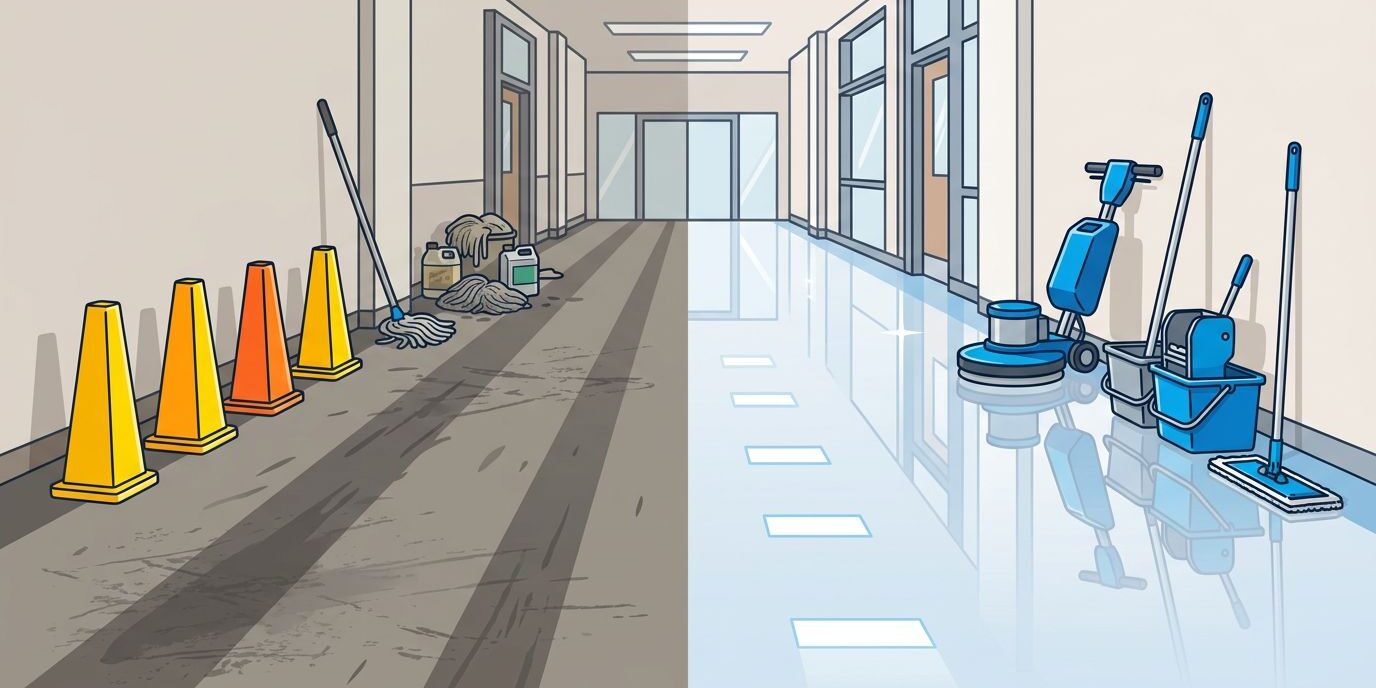
A worn floor can change the way people view an entire commercial building. Scratches, a dull finish, dark traffic lanes, and ground-in soil make even a well-maintained facility look neglected. Commercial floor stripping and waxing removes the damaged finish and replaces it with a clean, protective surface.
The process involves more than just running a floor machine across the room. Our team must select the right products, protect nearby surfaces, manage moisture, and allow each finish coat to dry correctly. With the right plan, we can significantly improve floor appearance, simplify daily maintenance, and help extend the overall floor lifespan.
Key Takeaways
- Professional stripping and waxing removes old finish, embedded soil, and worn layers that routine mopping cannot fix.
- The correct method depends on the floor type, finish product, traffic level, and building schedule.
- Thin coats, proper drying time, and careful preparation produce better results than rushing the job.
- A robust floor maintenance program, including daily dust-mopping and auto-scrubbing, reduces the need for frequent full stripping.
- A written scope should cover floor areas, furniture movement, safety controls, products, scheduling, and the restoration of the floor surface for extra charges.
Why Commercial Floors Need Stripping and Waxing
Commercial floors receive heavy use every day. Constant foot traffic brings in sand, grit, oils, and outdoor moisture, which often result in unsightly scuff marks. Carts, chairs, desks, equipment, and cleaning traffic add more wear. Over time, the finish becomes cloudy, scratched, uneven, or discolored.
Routine cleaning removes surface soil, but it does not remove every damaged layer. A mop can clean the top of a floor while leaving old finish and trapped dirt below. That is why a floor may look cleaner after mopping but still appear gray or worn.
Stripping breaks down the old wax so we can effectively remove it from the floor along with layers of degraded floor finish. Waxing, which usually means applying a commercial floor finish, adds new protection. The result is a more uniform appearance with a surface that is easier to maintain.
A properly finished floor also supports the professional image of a building. Offices, medical facilities, schools, banks, retail spaces, restaurants, hotels, and clubhouses all benefit from clean, well-maintained floors. Guests may not comment on a polished floor, but they notice when flooring looks dirty or neglected.
Professional floor care also helps protect the original floor surface from permanent damage. A high-quality finish takes much of the daily abuse before the flooring material itself begins to show signs of wear. This approach can delay costly repairs or full replacement, especially in high-traffic corridors and entrances.
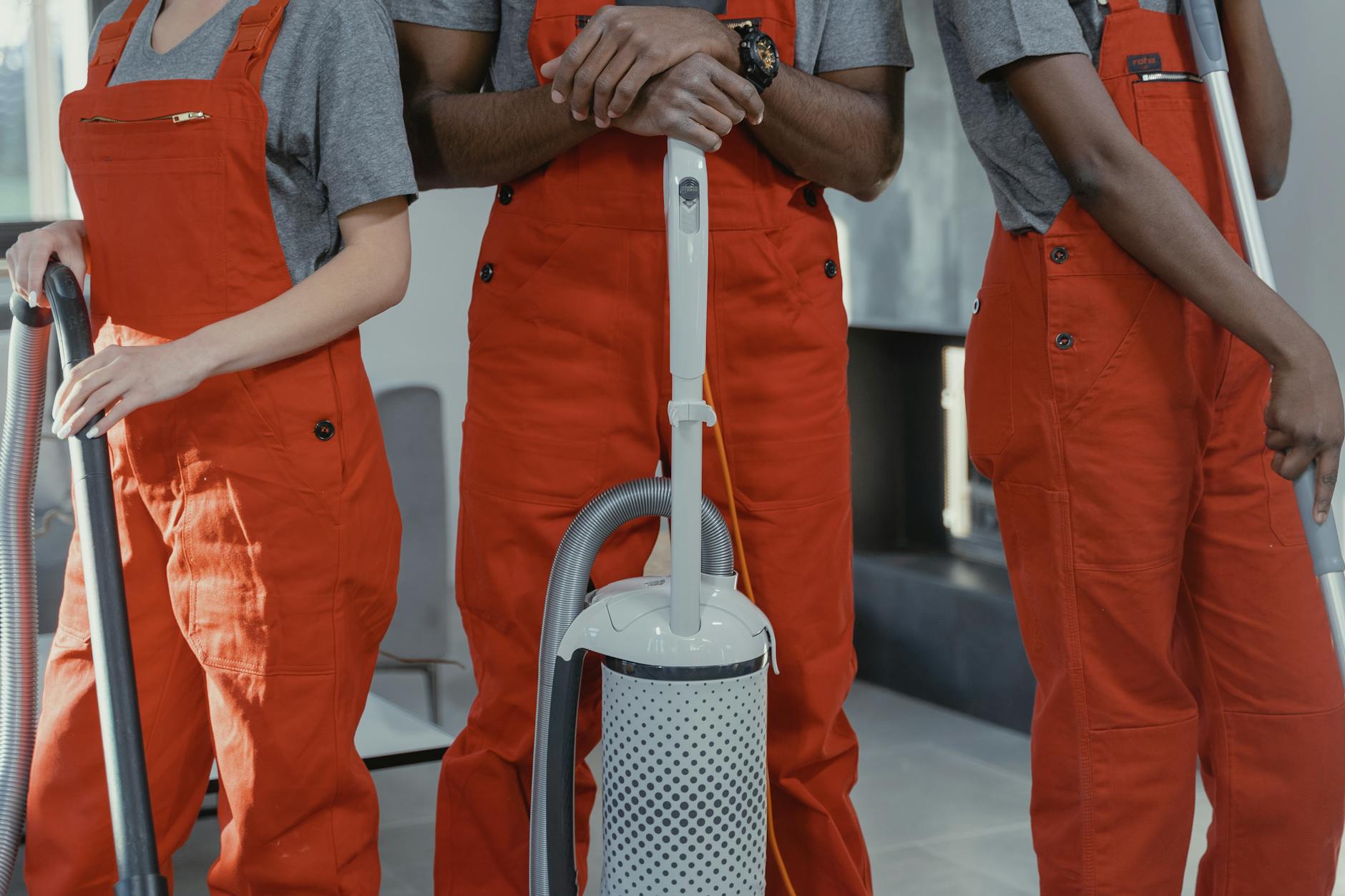
Photo by Tima Miroshnichenko
Which Commercial Floors Can Be Stripped and Waxed?
Not every hard-surface floor should receive the same treatment. Before work begins, we need to identify the material and check the manufacturer’s care instructions. Using the wrong chemical or pad can stain, scratch, soften, or permanently damage the surface.
Vinyl composition tile, commonly called VCT, is one of the most common floors for stripping and finishing. It accepts a high-quality commercial floor finish well and can be restored several times during its service life. Many schools, offices, retail stores, and healthcare spaces use VCT because it is durable and practical.
Some sheet vinyl and resilient flooring products can also receive finish, but the product instructions must be checked first. Linoleum may need a different cleaner and finish system than VCT. Older flooring may also contain asbestos, especially in buildings constructed many decades ago. We should never sand, scrape, or disturb questionable materials without proper testing and procedures.
The following guide helps us choose the right starting point:
| Floor type | Typical care approach | Main concern |
|---|---|---|
| VCT | Strip and wax with compatible floor finish | Use the correct pad and finish system |
| Sheet vinyl | Clean or refinish according to manufacturer instructions | Avoid harsh chemicals and excess moisture |
| Linoleum | Use approved cleaner and finish | Strong alkaline stripper may damage the surface |
| Terrazzo | Clean, seal, and polish with a suitable system | Traditional floor wax may not be appropriate |
| Ceramic or porcelain tile | Deep clean grout and surface | Finish is usually not applied like VCT wax |
| Natural stone | Use stone-safe cleaner and sealer | Acidic products can etch the stone |
| Wood or laminate | Use the flooring manufacturer’s care system | Wet stripping can cause swelling or damage |
A building may contain several floor materials in one service area. Restrooms may have tile, offices may have VCT, and entrances may have terrazzo or stone. We should map these surfaces before preparing a work plan.
How to Strip and Wax a Commercial Floor
Professional floor restoration follows an orderly process. Skipping one step often creates visible problems later, such as a cloudy finish, peeling edges, sticky residue, or uneven gloss.
1. Inspect the floor and plan the work area
We begin by checking the floor type, finish condition, traffic lanes, damaged sections, baseboards, drains, thresholds, and nearby furniture. Deep scratches or loose tiles may require repair before stripping starts.
The inspection also helps us select equipment and estimate labor. A small office may need a different plan than a school hallway or busy retail store. We should record the square footage that will actually be serviced, not areas that are locked, filled with storage, or excluded from the agreement.
2. Remove furniture and prepare the room
Furniture, wastebaskets, mats, signs, and movable equipment should be removed from the work area. Desks and heavy fixtures may need to stay in place, but we should plan around them instead of trapping old finish underneath.
We vacuum or dust mop the floor first. Loose grit can scratch the surface during machine work. Baseboards, walls, cabinets, doors, and nearby materials should be protected from splashes. We also post wet floor signs and restrict access before applying any solution.
After hours work is often useful for offices, schools, and retail buildings. The schedule should allow enough time for stripping, rinsing, drying, finishing, and safe reopening.
3. Apply the correct stripping solution
The floor stripper must be mixed and used according to its label. Stronger is not always better. Excess chemical can create residue, damage flooring, or increase rinse time.
We work in manageable sections rather than covering the entire building at once. The solution needs enough dwell time to soften the old finish, but it must not dry on the floor. Dry stripper can leave a difficult film and may require additional labor.
Edges and corners usually need hand work because a rotary machine cannot reach them. We use suitable tools around walls and fixtures while taking care not to gouge the flooring or damage painted surfaces.
4. Agitate and remove the old finish
A rotary floor machine or floor buffer paired with the correct scrubbing pad helps loosen the finish. Pad choice depends on the floor, product, and level of buildup. Aggressive pads can remove heavy finish faster, but they can also damage a vulnerable surface.
We collect the slurry with a wet vacuum or automatic scrubber. Leaving dirty solution on the floor allows soil and softened finish to settle again. It can also push residue into grout lines, seams, and floor edges.
Machines should be handled by trained workers. Cords must stay clear of wet areas, and electrical equipment should be used with proper safety controls. The floor remains closed while this work continues.
5. Rinse and check for residue
After the old finish is removed, we rinse the floor as directed by the product manufacturer. Some systems require a neutralizing step, while others specify a no rinse method. We should follow the label instead of using the same procedure for every product.
The surface needs a careful inspection before new finish is applied. We look for dull patches, sticky areas, remaining finish along edges, and visible streaks. If residue build up remains, the new coat may bond poorly or look cloudy.
A clean rinse is one of the most important parts of floor restoration. Applying finish over stripper residue is like painting over dust. The problem may not show immediately, but it often appears as uneven gloss, peeling, or discoloration.
6. Allow the floor to dry completely
Moisture must leave the floor before finishing begins. We use ventilation and allow enough time for the surface to dry naturally. Fans can help air movement, but they should not blow dust across a clean floor.
The floor should feel clean and dry, without tackiness or visible film. We also check corners and seams because water often remains in those areas longer. Starting too soon can trap moisture under the finish and weaken the result.
7. Apply thin, even coats of finish
Commercial floor finish should be applied in thin, consistent coats. Heavy coats can dry slowly, show marks, or remain soft beneath the surface. We use the applicator recommended for the product and keep a wet edge to reduce overlap lines.
Most floors need multiple coats, but the exact number depends on the product, existing condition, and expected use. Each coat needs the manufacturer’s recommended drying time before the next one. We do not place furniture back or open the area to traffic while the finish is still vulnerable.
The final floor appearance should be uniform across the entire service area. We inspect the floor under normal building lighting, not only under a work light. A finish that looks acceptable in one corner may show streaks when viewed across a long hallway.
How Often Should Commercial Floors Be Stripped?
There is no single schedule for every building. Floor traffic, entrance conditions, cleaning quality, finish thickness, furniture movement, and the type of flooring all affect the timing of when you should strip and wax your floors.
A busy school hallway or retail entrance represents high-traffic areas that may need more frequent attention than a private office with limited visitors. These spaces collect grit quickly, especially during rainy weather. Medical buildings and restaurants may also require a strict maintenance plan because their appearance and hygiene standards remain high.
We should not decide to strip and wax a floor simply because a calendar date has arrived. Instead, we should inspect the finish for signs of wear:
- Traffic lanes remain dull even after routine cleaning.
- Scratches expose the floor or create dark lines.
- The finish looks thin near entrances and counters.
- Daily cleaning no longer restores the expected appearance.
- New finish cannot be built evenly over the existing layers.
- Soil collects in worn areas despite proper mopping, and your daily maintenance results have become ineffective.
A regular maintenance program can delay the need for a full service. Daily dust mopping removes abrasive grit. Entrance mats reduce the amount of soil that reaches the floor. Auto-scrubbing with a neutral cleaner supports a clean appearance without removing the protective finish, allowing you to get the most value out of your floor care investment.
Daily and Weekly Floor Maintenance
While professional stripping and waxing restores a floor to its original luster, consistent daily maintenance is what preserves that finish over the long term. Without a reliable routine, grit and debris will quickly wear through the new coating just as it wore through the old one.
You should prioritize dust mopping high-traffic areas each day to protect your investment. Microfiber dust mops are highly effective because they collect loose soil without pushing it into corners. Spills also require prompt attention, as moisture and oils can soften the finish or create dangerous slip hazards.
For larger buildings, an automatic scrubber can significantly improve your cleaning consistency. The machine should always use the correct pad or brush, clean water, and a floor-safe solution. Using too much detergent can leave behind a tacky film that attracts more soil, and it is vital that dirty solution is removed promptly rather than left to dry on the surface.
Entrance mats are another critical component of floor protection. Mats only function properly when they are positioned correctly, kept clean, and replaced or rotated when they become saturated. A dirty mat can actually spread soil across the building rather than stopping it at the entrance.
During your routine service, you should inspect edges, corners, transitions, and areas beneath movable furniture. These specific locations often show signs of wear first. By providing early attention to these spots, you may only need a light cleaning or recoating instead of a full strip.
The best professional floor care program combines periodic stripping and waxing with consistent daily maintenance.
Building a Floor Care Budget and Scope
A reliable budget starts with accurate measurements and a clear scope. Professional commercial cleaning services often determine costs by assessing the square footage and the specific floor surface type. It is essential to separate areas that need full restoration from zones that only require routine maintenance or simple recoating.
Labor and materials are significantly affected by the current condition of the floor. Factors such as multiple layers of heavy buildup, the need for furniture movement, floor repairs, restricted access, and after-hours work can increase the total cost. Your estimate should identify exactly what is included, such as rinsing, drying time, the specific number of layers of floor finish, equipment, setup, and the final inspection.
A written scope should answer practical questions before the crew arrives to strip and wax your floors:
- Which rooms, hallways, and entrances are included?
- Which floor types will receive each specific treatment?
- Who is responsible for moving furniture and equipment?
- How many coats of floor finish are planned for the project?
- What cleaning products and scrubbing pads will be used?
- When can the area be reopened for foot traffic?
- Are specific repairs, deep stain removal, or detailed edge work included?
- What tasks would be considered extra work outside of the base contract?
Monthly billing, advance billing, and post-service billing options can affect your facility cash flow. All potential extra charges should be clearly defined before work begins. You can request a free floor care estimate and ask for a detailed scope that aligns with your building, maintenance schedule, and actual service needs.
A clear proposal also helps you accurately compare providers. The lowest price may not include the same number of finish coats, preparation steps, or safety controls. When evaluating options, you should compare the complete service package rather than simply looking at the first price on the page.
Choosing a Commercial Floor Care Provider
The right provider should have extensive experience with the specific floor types and building conditions found in your facility. Office floors, healthcare facilities, schools, restaurants, and retail spaces all have different access rules, traffic patterns, and unique cleaning concerns that require tailored professional floor care.
We should always verify that the company is properly licensed, insured, and bonded. Insurance protects your property and your business if an accident causes damage or injury. Comprehensive training is equally important. Workers should know how to properly operate floor machines, handle potent cleaning chemicals, protect surrounding surfaces, and maintain appropriate slip resistance while applying stripping and waxing products. They must also be fully prepared to respond to wet-floor hazards to ensure safety during the process.
A dependable company should provide a clear point of contact. You should know exactly who handles schedule changes, missed areas, damage reports, and follow-up questions. Consistent, written inspection records or service reports make overall performance much easier to review.
References should come from facilities similar to yours. A provider that performs well in a small office may need a completely different crew and process for a school, hotel, medical building, or large retail property. You should also ask how the company handles staff absences and ensures service continuity.
Pro Shine Cleaning Services provides high-quality commercial cleaning services and janitorial support in Fort Myers, Cape Coral, Naples, Bonita Springs, and Lehigh Acres. Building managers can learn more about commercial cleaning support from Pro Shine and discuss their specific floor care needs with our professional team today.
Common Floor Stripping and Waxing Mistakes
Many floor problems begin before the machine even starts. Misidentifying the material, skipping a test area, or using an unsuitable stripper can cause permanent damage to your surfaces.
Rushing the work creates other common issues. If the stripper dries before removal, the floor may require another application. Furthermore, if the rinse is incomplete, residue build-up can cause the floor finish to turn cloudy. If the surface is still damp when the new coating is applied, it may bond unevenly, leading to premature peeling.
Applying thick finish coats is another frequent error. More product does not always create better protection. In fact, removing old wax and applying thin coats with proper drying time usually produces a more professional result, making it easier to correct any minor defects.
We should also avoid opening the floor too soon. Heavy foot traffic, rolling carts, and furniture can mark the finish before it has fully hardened. The provider should give clear reopening instructions based on the specific products used and the current building conditions.
Finally, a professional service should not replace your routine cleaning plan. Even a newly completed strip and wax job requires consistent daily maintenance, such as regular dust removal, prompt spill response, clean equipment, and the use of suitable chemicals. Without those ongoing steps, wear and tear will return much faster than expected.
Frequently Asked Questions
How often should my commercial floors be stripped and waxed?
The frequency depends on your facility’s traffic levels and daily maintenance routine rather than a set calendar date. High-traffic areas like entryways and hallways typically require more frequent attention than private offices, as you should look for signs of wear like dull traffic lanes, deep scratches, or ineffective daily cleaning before scheduling service.
Can I use the same cleaning process for all my building’s floors?
No, each floor material requires a specific approach to avoid permanent damage. For example, vinyl composition tile (VCT) is designed for stripping and finishing, while materials like natural stone or wood require specialized, non-acidic cleaners and sealers to prevent etching or swelling.
Why is my floor cloudy after a new wax application?
Cloudiness is often caused by incomplete rinsing or trapping moisture under the finish layers. When stripper residue remains on the floor, the new wax cannot bond properly, resulting in a dull or streaky appearance that may eventually lead to peeling.
How long does the floor need to be closed after waxing?
The reopening time depends on the specific floor finish product used and the environmental conditions like temperature and humidity in your building. It is critical to follow the professional’s guidance regarding foot traffic to ensure the finish has cured completely and can withstand daily wear.
Conclusion
Investing in professional commercial floor stripping and waxing is essential for revitalizing your facility, as this process significantly improves your overall floor appearance while maximizing your total floor lifespan. Achieving the best results requires a disciplined approach, from identifying the floor material correctly and removing old finish completely to rinsing thoroughly, allowing for proper drying time, and applying new coats at the correct thickness.
A successful long-term strategy also incorporates consistent floor maintenance, including daily dust removal, regular inspections, entrance mat upkeep, and a clearly defined written service scope. When these tasks are handled by trained professionals, your buildings remain cleaner, safer, and more welcoming for employees, visitors, and customers alike.