A public restroom can look fine at noon and feel neglected by 3 p.m. That gap is where complaints start, odors settle in, and trust drops fast.
Commercial restroom cleaning standards for busy buildings are not about wiping a sink and calling it done. They are about keeping the room clean, stocked, functional, and ready for the next rush, every single day.
Key Takeaways
- Align Cleaning with Foot Traffic: Move beyond static schedules by tailoring inspection and cleaning frequencies to match the specific usage patterns and peak hours of your building.
- Prioritize High-Touch Surfaces: Focus daily efforts on frequently touched areas like door handles, stall latches, and faucets to minimize the spread of bacteria and maintain hygiene.
- Never Wait for Depletion: Keep soap, paper towels, and tissue at comfortable buffer levels to avoid supply shortages and ensure building users always have access to essential amenities.
- Implement Routine Deep Cleaning: Supplement daily maintenance with a deep-cleaning schedule that targets grout, vents, and behind-fixture zones to prevent odor buildup and long-term surface degradation.
- Document for Accountability: Use simplified logs to track cleaning activities, identify recurring facility issues, and provide proof of compliance with safety and sanitation standards.
What the standard really means in a busy building
Commercial restrooms in high-traffic buildings need more than a basic once-a-day cleaning. The room must remain a sanitary environment throughout the day, rather than just appearing clean after the overnight crew finishes their shift.
OSHA regulations, specifically 29 CFR 1910.141, set the essential baseline for workplace restrooms. These spaces must be kept clean, functional, and properly stocked with soap and hand-drying supplies. Maintaining these standards is critical in public restrooms, where high usage increases the risk of spreading bacteria and viruses among employees and visitors.
That sounds simple until foot traffic picks up. An airport, school, clinic, or mall restroom can fall apart fast if cleaning is too light or too late. One missed trash can quickly turn into a floor issue. One empty soap dispenser turns into a complaint. One broken latch becomes a bigger problem than visible dirt.
The real standard is performance under pressure. If the restroom cannot handle a lunch rush, shift change, event traffic, or morning arrival peaks, it is not meeting the job requirements.
A restroom that smells clean but runs out of soap is still failing the people who use it.
Build the schedule around traffic, not the clock
A fixed schedule sounds tidy on paper, but real buildings do not stay tidy on paper. High-traffic public restrooms require inspection windows that match the rhythm of the building. A school has different pressure points than a retail center, and an office tower peaks differently than an airport concourse. Professional commercial cleaning services should always align their schedules with these unique patterns.
Here is a simple way to think about it:
| Facility type | Inspection pace | Full cleaning cadence | Restocking |
|---|---|---|---|
| Busy office building | Every 1 to 2 hours during the day | At least once daily, plus spot cleaning | Restock supplies several times per day |
| Mall or retail center | Frequent checks during open hours | Daily, with mid-day touch-ups | Many short visits to restock supplies |
| School or campus building | Before heavy use, after lunch, and after events | Daily, with deeper service after peak use | Restock supplies before known rushes |
| Airport or transit space | Continuous or near-continuous checks | Multiple times per day | Constant monitoring to restock supplies |
The point is not to chase a magic number. The goal of quality commercial cleaning services is to keep public restrooms ahead of complaints.
The daily tasks that matter most
Some tasks matter every time. Skip them, and the whole room slips.
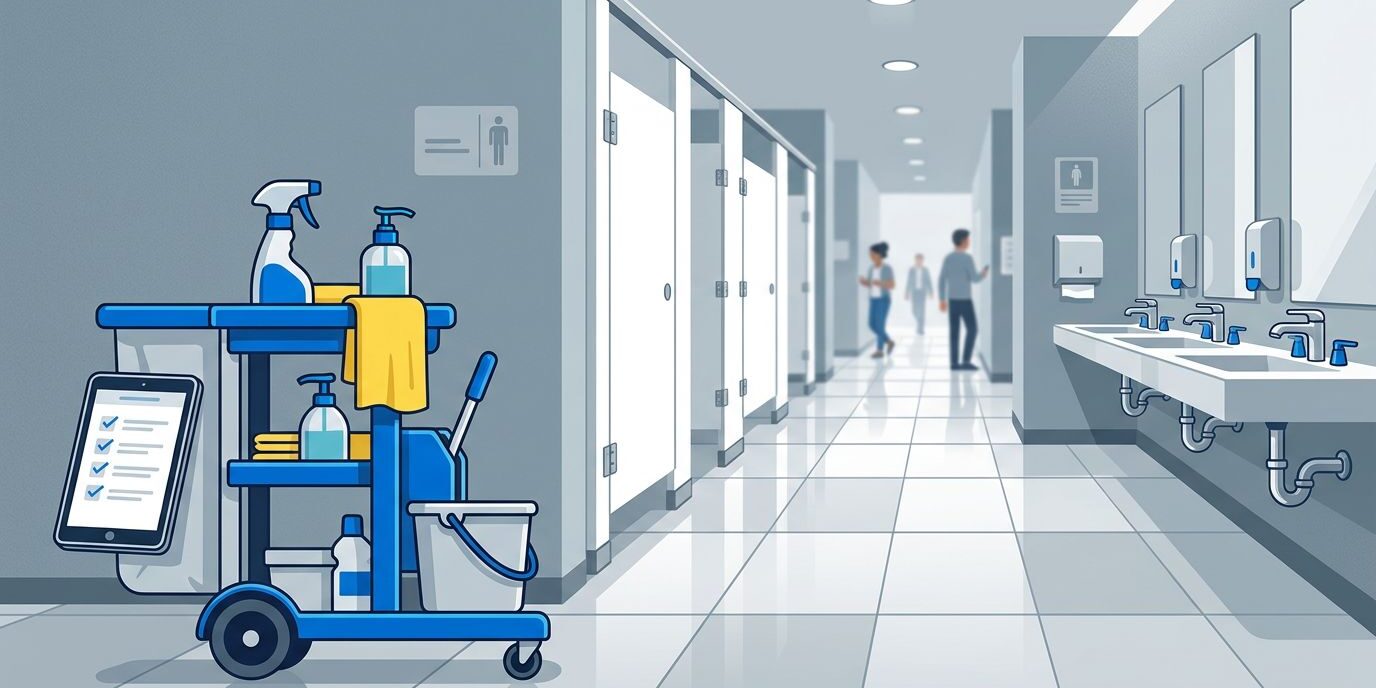
Start with the high-touch surfaces people notice first. Door handles, stall latches, faucet handles, flush buttons, and soap dispensers require constant attention because everyone touches them. It is essential to clean these high-touch surfaces regularly to maintain hygiene. Trash should never overflow, and floors should be managed carefully to ensure safety.
A strong daily routine usually includes these basics:
- Clean and disinfect fixtures including urinals and toilets before and after peak traffic. Using a quality disinfectant cleaner helps neutralize germs on these high-traffic areas.
- Empty trash and hygiene bins before they overflow.
- Restock soap, tissue, and towels before they run out.
- Wipe sinks, counters, and fixture bases with microfiber cloths so buildup does not harden.
- Sweep and mop the floor so water, grit, and spills do not spread. Always use wet floor signs to alert occupants of slipping hazards.
- Check stalls, locks, and flushing systems so the room works as expected.
The order matters as much as the products you choose. Start high, then move low. Clean surfaces before floors to prevent debris from falling onto clean areas. When cleaning urinals and toilets, always wear appropriate personal protective equipment to ensure staff safety. To prevent cross-contamination, use fresh supplies for every task rather than reusing dirty cloths.
Finally, remember that your disinfectant cleaner needs the proper dwell time, which means the product must stay wet on the surface long enough to effectively eliminate bacteria. This is where many restrooms fail. They do not look dirty enough to trigger panic, but they are never quite clean enough to feel cared for.
Keep supplies visible and never at the edge
People notice empty dispensers faster than polished floors. They also remember them longer.
To maintain high standards in public restrooms, soap dispensers, paper towels, and toilet tissue need a comfortable buffer. A dispenser that is at 5 percent capacity does not help anyone, and a trash bin that looks full will quickly become a magnet for litter. Reliable teams prioritize the need to restock supplies before levels hit that critical threshold.
The best janitorial crews do not wait for the last roll to appear. They monitor usage patterns to restock supplies based on the specific needs of the building rather than a generic supply sheet. Consistently maintaining adequate paper towels and soap dispensers is also essential for encouraging proper handwashing compliance among building occupants.
It also means checking the less glamorous details. Is the hand dryer working? Are the soap dispensers functioning fully, or are they just dripping? Is there tissue in every stall, or only in the one nearest the door? Is the baby changing station clean and secure? Is there a smell that points to a blocked drain or trash buildup?
Good restroom service feels invisible because it stays ahead of the edge. Once people start discussing shortages, the standard has already slipped.
Deep cleaning is where odors lose their hiding places
Daily cleaning keeps the room usable, but regular deep cleaning is essential to prevent long-term wear and tear. When you commit to a consistent deep cleaning schedule, you ensure that your facility maintains high hygiene standards that daily maintenance alone cannot achieve.
Grout lines, floor edges, the base behind toilets, vents, drains, partitions, and the undersides of sinks collect residue that a quick daily round simply will not touch. In high-traffic buildings, these areas accumulate buildup faster than most people realize. That is where odors begin to linger and where persistent stains settle into surfaces. Without deep cleaning, a room begins to feel worn and neglected even when the fixtures are relatively new.
Effective maintenance should cover more than just surface dirt. It should include intensive grout and tile scrubbing, the use of hospital-grade disinfectants to eliminate germs, and descaling on fixtures to remove mineral deposits. If your facility deals with hard water, this process is even more critical, as mineral buildup can make even a sanitized room look tired. For large areas, using a professional floor scrubber can significantly improve the results on grout and tile surfaces. When you thoroughly sanitize these hidden zones, you achieve superior odor control and extend the lifespan of your restroom components.
Some facilities require a deep pass after closing, while others perform these tasks on weekends or during low-traffic windows. The timing depends on your specific foot traffic, but the necessity remains constant. If the room never receives a comprehensive reset, your daily wipe-down must carry too much weight, leading to inevitable degradation.
A practical deep-clean plan usually targets:
- Grout and caulk lines
- Floor drains and baseboards
- Behind and around urinals and toilets
- Vent covers and partition edges
- Sink undersides and faucet bases
- High walls near splash zones
- The base and plumbing connections of urinals and toilets
Train the crew to spot problems before they spread
A restroom crew does more than clean. It watches for failure.
That means training people to notice slow drains, loose fixtures, broken locks, missing supplies, graffiti, leaks, and recurring odor. A good cleaner sees the first signs before a building user files a complaint, which saves time, money, and frustration. Implementing a standardized cleaning procedure ensures that every team member knows exactly what to look for during their rounds.
Training also keeps standards steady when different shifts, teams, or vendors come through the building. Without a common routine, one crew may restock aggressively while another waits too long. One person may disinfect correctly to eliminate bacteria and viruses, while another wipes surfaces too quickly. By adopting color-coded cleaning systems, you can easily prevent cross-contamination and ensure that staff follow the correct cleaning procedure for every surface in the facility.
Consistency matters more than heroics. The goal is not one perfect shift; the goal is the same high-quality result every day. For facility leaders, this highlights why many businesses choose professional commercial cleaning services to maintain these rigorous standards compared to internal management.
For your internal team, written instructions should be short, clear, and visible. Crew members should know what gets checked each round, what gets logged, and what gets escalated. A restroom problem that stays unreported becomes a bigger issue by the hour.
If your team cannot keep up with the traffic, Get a FREE Quote Today and compare a professional restroom plan against what you are doing now.
Good records turn cleaning into proof
A clean restroom is good. A clean restroom you can prove is better.
Logs help show what was done, when it was done, and who did it. That matters for property managers, operations teams, and compliance staff. It also helps spot patterns. If the same area in your public restrooms keeps running short on tissue at 11:30 a.m., that is a scheduling problem, not a mystery.
The best logs stay simple. They should capture the basics without turning into paperwork nobody wants to touch. Record the time, the area checked, any supply issues, any repairs needed, and whether a follow-up was done.
A good audit trail helps in three ways:
- It shows the room is being checked often enough.
- It reveals repeat problems before they become complaints.
- It gives managers a clean handoff when shifts change.
Maintaining thorough records is also a vital step when preparing for health inspections. Furthermore, this documentation helps ensure your facility remains in alignment with OSHA regulations. Many teams compare their procedures to plain-English summaries, such as SHRM’s overview of restroom rules. That kind of reference helps keep internal standards tied to real requirements, not guesswork.
When the room itself is part of the problem
Sometimes the issue is not the cleaning process at all; it is the room itself.
A restroom with too few fixtures, poor ventilation, broken hardware, or inefficient traffic flow will always be difficult to maintain. The janitorial crew can work diligently and still lose the battle by lunchtime. This is why building operations and janitorial planning must remain in constant communication.
If stalls back up near the busiest entrance, people crowd the space and dirt spreads quickly. When urinals and toilets are poorly positioned, soap dispensers often end up in splash zones where they require frequent cleaning or replacement. Furthermore, if ventilation is inadequate, effective odor control becomes nearly impossible, even after a thorough scrub. When the layout forces occupants to traverse the entire room just to reach a sink, the floors naturally become dirty faster.
The solution may be as simple as adjusting service timing, but it often requires rethinking the placement of urinals and toilets, improving airflow, or redesigning traffic flow. Successful facility management looks at public restrooms as a complete system rather than just a space that needs a mop bucket.
This is why high-traffic facilities require regular operational reviews rather than just regular cleaning. Your maintenance plan should be dynamic, evolving whenever the building usage or layout changes.
Frequently Asked Questions
How often should high-traffic restrooms be inspected?
Inspection frequency should be dictated by the volume of your facility’s traffic. While office buildings may need checks every 1 to 2 hours, busy spaces like airports or transit centers require nearly continuous monitoring to ensure supplies stay stocked and surfaces remain clean.
Why does my restroom still smell even after it is cleaned?
Lingering odors often originate from hidden buildup in grout lines, floor drains, or behind fixtures that daily surface cleaning cannot reach. Implementing a regular deep-cleaning schedule is essential to sanitize these hidden zones and neutralize odors at their source.
What is the purpose of dwell time in cleaning?
Proper dwell time refers to the duration a disinfectant must remain wet on a surface to effectively eliminate bacteria and viruses. Many restrooms fall short of hygiene standards because cleaners wipe surfaces dry too quickly, preventing the product from working as intended.
How can I stop restrooms from running out of supplies?
Avoid a generic restocking schedule and instead monitor usage patterns to restock supplies based on actual building demand. Keeping a buffer of products available—rather than waiting for a dispenser to become completely empty—ensures you stay ahead of the next rush.
Conclusion
Busy restrooms do not forgive sloppy routines. They show every missed refill, every late check, and every ignored spill.
The strongest commercial restroom cleaning standards are the ones built around actual use rather than simple habit. These practices keep the room clean, stocked, functional, and ready for the next wave of people. By maintaining a consistent schedule, you eliminate the places where bacteria and viruses thrive, ensuring that the facility remains a safe and sanitary environment for everyone. These standards also make room for deeper cleaning, better records, and faster fixes when something breaks.
If a restroom can hold up during peak traffic, it is doing its job. If it cannot, the schedule needs another look.