
A clean property is not measured by appearance alone. Commercial cleaning KPIs help property managers confirm that janitorial services are completed on time, meet agreed standards, and support a safe, professional facility.
Without clear numbers, missed tasks, slow responses, rising labor costs, and repeated complaints can continue unnoticed. This article focuses on a practical set of cleaning industry KPIs that connect service completion, tenant experience, safety, and budget control.
Key Takeaways
- Commercial cleaning KPIs help property managers measure service quality, task completion, response times, tenant satisfaction, safety, and budget performance.
- Inspection scores, task completion rates, First-Time Fix Rate, and customer response times should be tied to a written service scope and clear service level agreements.
- Cleaning budgets should account for direct labor, supplies, equipment, periodic work, invoice variance, and property-specific factors such as traffic, weather, and occupancy.
- Staff continuity, training, safety records, corrective actions, and green cleaning compliance can directly affect service reliability and building safety.
- Start with a small set of reliable KPIs, collect consistent records, and review them on a daily, weekly, or monthly schedule based on the property’s needs.
Why These Metrics Matter for Your Facility
Property managers and facility managers are responsible for more than keeping floors and restrooms clean. They also manage tenant expectations, service contracts, building safety, operating costs, and the overall impression a property gives visitors.
Key performance indicators turn a general concern into a measurable result. Instead of saying that service feels inconsistent, you can review service quality scores, completed tasks, complaint response times, and follow-up records. This makes conversations with a cleaning provider more productive and less subjective.
Facility management resources often group cleaning metrics into service quality, costs, safety, maintenance, and occupant experience. The same approach works well for janitorial services. The facility management KPI guide from FMX also connects performance tracking with better resource allocation and operational efficiency.
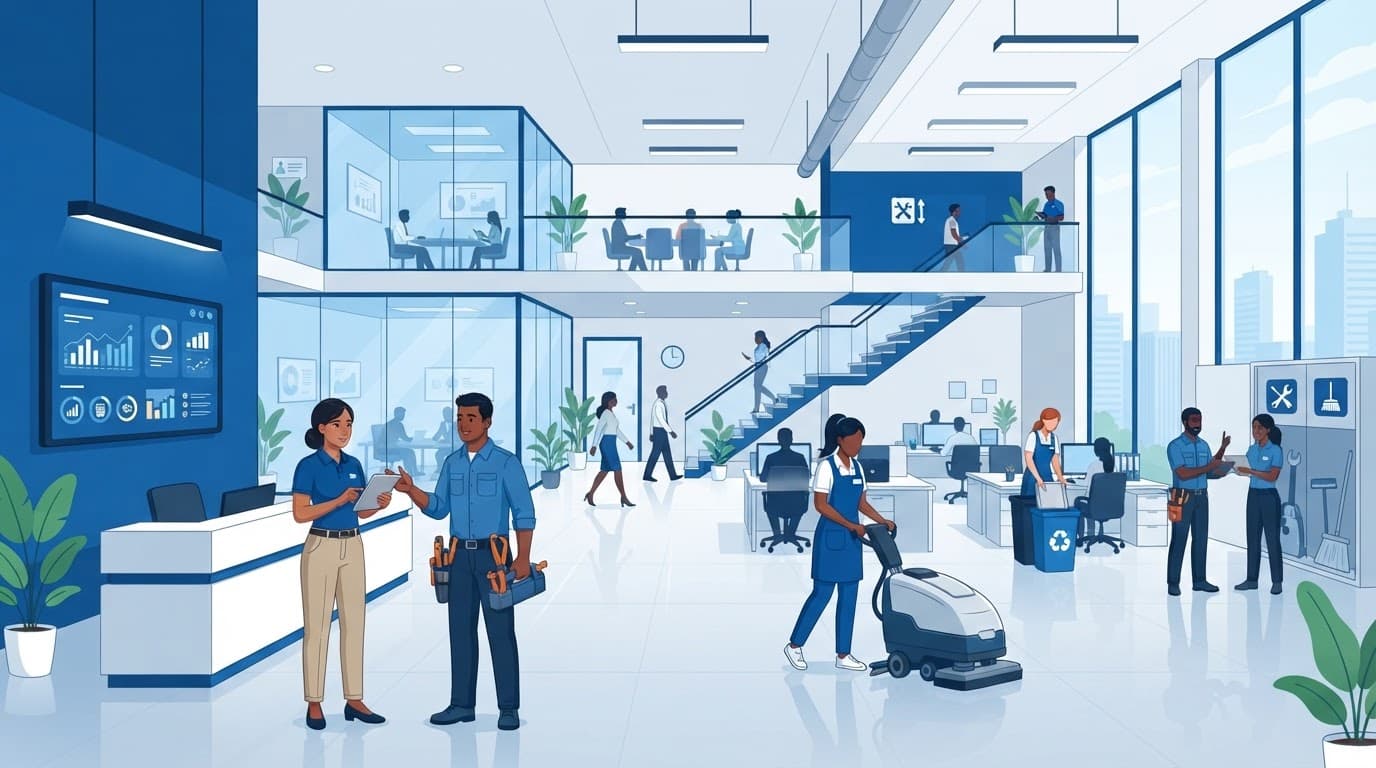
The best measurement system doesn’t need dozens of complicated reports. It needs a written service scope, service level agreements that define response expectations and service standards, consistent inspections, reliable records, and a clear quality control process for correcting problems.
The Core Service Quality KPIs to Track
Cleaning performance should be reviewed against the actual building, traffic level, flooring, operating hours, and tenant needs. These cleaning industry KPIs should be adapted to each property, not treated as universal targets.
The following cleaning metrics are useful starting points for common service measures:
| KPI | Basic calculation | Practical starting point |
|---|---|---|
| Inspection quality score | Points earned divided by total inspection points | 90% or higher for a general office |
| Task completion rate | Completed scheduled tasks divided by scheduled tasks | 95% or higher |
| Urgent response time | Time opened to time acknowledged | Less than one hour |
| Routine response time | Time opened to time acknowledged | Same day or within 24 hours |
| First-Time Fix Rate | Issues resolved during the first response divided by total issues | Establish a baseline and improve monthly |
These targets should be adjusted to the property. Medical and dental facilities may need higher inspection standards for restrooms, waiting areas, touchpoints, and waste handling. High-traffic properties may need more frequent inspections rather than one end-of-month review.
Service quality scores and inspection results
A quality score should come from a written quality control form. Review the entrance, lobby, restrooms, floors, break rooms, elevators, common areas, and other spaces included in the contract.
A restroom inspection may check for dry floors, stocked dispensers, clean fixtures, no visible soil, and acceptable odor control. Lobby glass may need to be streak-free at normal viewing distance. Properties with sustainability requirements may also inspect green cleaning practices, such as approved products and waste separation. These details create an objective standard for both the property manager and cleaning company.
Photo documentation adds useful support. A time-stamped image can confirm completed work or show the condition that caused a complaint. Photos should focus on the area, not employees, private records, patients, or confidential tenant information.
Review service quality scores alongside corrective action closure. If a failed item is corrected, record when it was reported, who handled it, and when it was completed. A facility cleaning performance KPI reference includes inspection results, response times, task completion, and corrective action as connected measures.
Task completion rates and First-Time Fix Rate
A crew can spend the expected number of hours inside a property without completing every required task. That is why hours alone don’t measure cleaning efficiency.
The task completion rate compares completed work with scheduled work. Digital tools such as checklists, supervisor inspections, and time-stamped records can show whether missed tasks are isolated events or part of a recurring pattern.
The First-Time Fix Rate measures how often a reported issue is resolved during the first response. A high rate usually means the provider sends the right person, equipment, and supplies. A low rate may point to poor communication, unclear responsibilities, inadequate training, or missing materials.
The response process should not depend on a promise that nothing will ever be missed. Reliable service includes a clear way to report a problem, complete follow-up work, and document the correction.
Customer response time and satisfaction
Response time should be measured separately for urgent and routine requests. A water spill, restroom problem, safety concern, or access issue may require acknowledgment in less than an hour. A request for interior glass or periodic floor care may reasonably be handled within the same day or next business day.
Track the time a request is opened, acknowledged, assigned, resolved, and closed. This shows where delays happen. A company may answer quickly but take too long to complete the work.
Customer satisfaction can be measured with a short one-to-five survey after inspections, service issues, or monthly reviews. Track the score alongside complaints per service visit. A high inspection score with low tenant satisfaction may indicate poor communication, inconvenient scheduling, or a scope that no longer matches the building.
Financial KPIs That Protect the Cleaning Budget
Cleaning costs should be reviewed against the actual service delivered. A low monthly price may look attractive when the scope excludes carpet extraction, interior glass, high dusting, floor machine work, emergency cleanup, or post-event service. Direct labor and account-level expenses should be evaluated against the provider’s profit margin.
The main labor cost formula is:
Direct cleaning labor costs divided by cleaning revenue, multiplied by 100
Direct labor should include wages and related payroll costs tied to the account. Supplies, equipment, travel, subcontracting, and administrative expenses should be tracked separately so the property manager can see the full cost of service. Product requirements and green cleaning standards can affect supplies, labor, and periodic work. For a cleaning business, client acquisition cost is a separate overhead measure and shouldn’t be assigned to a property’s direct service charge.
For annual planning, we use a simple budget formula and compare actual service volume against it to support operational efficiency:
Cleanable square footage x service rate x number of service periods + planned periodic work
Measure only the spaces included in the cleaning plan. Locked rooms, storage areas, and unused spaces should not be counted if they aren’t serviced. Revisit the budget when occupancy, floor area, traffic, hours, or tenant use changes.
Property managers should also track invoice variance. Compare the approved contract amount with extra charges each month. Every additional service needs a defined price and approval process. Unapproved extra charges or scope gaps can reduce the provider’s profit margin.
For a property in Fort Myers, Cape Coral, Naples, or another Southwest Florida market, weather can change the workload. Heavy rain, sand, humidity, and landscaping debris may increase entrance and floor maintenance. A customized plan is more accurate than a fixed schedule copied from another building. Businesses that need a clear scope and budget can Get a FREE Quote Today and request a detailed service estimate.
Staff Retention, Continuity, and Safety Records
Property managers may not control a cleaning company’s hiring decisions, but staff stability affects service quality. Frequent changes can lead to missed instructions, access problems, inconsistent methods, and repeated training.
The employee retention rate is calculated as:
(Employees at the end of the period minus new hires) divided by employees at the beginning of the period, multiplied by 100
Employee turnover is calculated using separations divided by average headcount. Some cleaning operations report annual turnover rates between 200% and 400%, but those figures aren’t a reason to accept unreliable service. Ask how the provider manages continuity, training, background checks, keys, alarms, and backup coverage.
A strong provider should have trained staff available when an assigned cleaner is sick, leaves the account, or cannot access the property. Digital tools can centralize missed shifts, replacement coverage, training completion, and supervisor visits.
Safety record tracking should include incidents, near misses, workers’ compensation claims, safety training, chemical handling, slips and falls, and corrective actions. If the provider maintains OSHA-related records, review osha recordable incidents alongside other safety data. OSHA-related housekeeping expectations include clear walkways, controlled hazards, and safe work areas. Cleaning records should show whether safety problems are reported and corrected.
Medical offices, schools, restaurants, and industrial areas may require additional controls for chemicals, sharps, bodily fluids, food areas, or restricted spaces. For green cleaning programs, staff may also need training on approved products and compliance requirements. The cleaning plan should identify these areas before service begins.
Digital Tools That Simplify Data Collection and Reporting
Paper checklists can work for a small account, but they become difficult across several properties. Digital tools can collect inspection findings, time records, photos, service requests, and corrective actions. Their checklists can also track compliance items, such as green cleaning.
Software solutions used in cleaning operations include Swept, Janitorial Manager, DataScope, Otuvy, and ZenMaid. Features differ, so these digital tools should support mobile checklists, real-time tracking, photos, reporting, customer communication, and quality control. A broader review of facility management metrics shows how better data can improve operational efficiency and inform occupant experience decisions. Providers can also track business-growth measures, such as client acquisition cost, separately from property-level service performance.
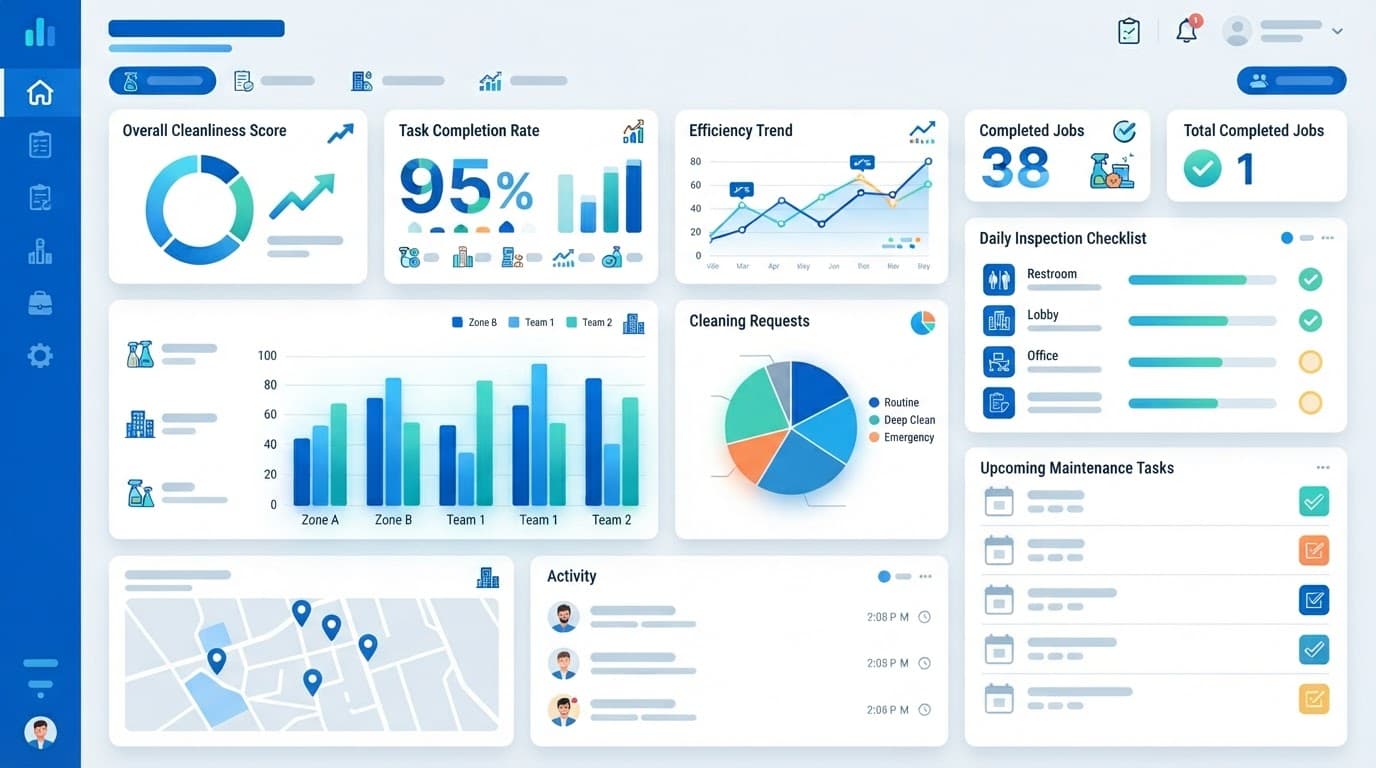
A smaller cleaning business does not need to purchase an expensive platform immediately. We recommend a practical rollout:
- Define the service scope and inspection standards in a shared document.
- Start with a spreadsheet or low-cost form for tasks, inspections, complaints, and response times.
- Add photo documentation for high-risk areas, completed corrective work, and recurring concerns.
- Use digital tools to review the first 30 days of data, set a cleaning efficiency baseline, and establish realistic targets from actual property performance.
- Move to dedicated software when multiple locations, supervisors, or service requests make manual tracking difficult.
Staff adoption also matters. Keep mobile forms short, train employees during paid work time, and explain how records protect good work instead of treating every entry as surveillance. Supervisors should review the information regularly and remove duplicate or unnecessary fields.
Set a KPI Review Schedule That Supports Better Service
Daily reports are useful for urgent issues and high-traffic facilities, especially when monitoring customer response time. They should separate urgent acknowledgments from routine service follow-up. Weekly reviews work well for inspection scores, missed tasks, restrooms, common areas, and open corrective actions. Monthly meetings should cover customer satisfaction, labor costs, invoice variance, staffing continuity, and safety record tracking. Properties with sustainability requirements should also review green cleaning compliance.
Each KPI should have one owner, one data source, and one documented quality control action when performance falls below target. Digital tools can use automated reminders or dashboards to surface overdue tasks. A quality score below target may require retraining or a scope review. Slow response times may require a better escalation process. Rising extra charges may show that the contract no longer matches the property.
Avoid tracking numbers that nobody uses. Five reliable measures are more useful than twenty incomplete reports and provide a clearer view of operational efficiency.
Frequently Asked Questions
What are the most important commercial cleaning KPIs?
Core measures include inspection quality scores, task completion rates, response times, First-Time Fix Rate, customer satisfaction, labor costs, and safety records. The right mix depends on the building type, service scope, traffic level, and tenant needs.
How often should property managers review cleaning KPIs?
Urgent requests and high-traffic areas may require daily monitoring, while inspections and corrective actions can be reviewed weekly. Monthly reviews should cover satisfaction, labor costs, invoice variance, staffing continuity, and safety performance.
What is a good task completion rate for janitorial services?
A practical starting point for many general office properties is 95% or higher. This target should be adjusted for the facility’s operating hours, traffic, flooring, service scope, and any specialized cleaning requirements.
How can digital tools improve cleaning KPI tracking?
Digital tools can centralize checklists, inspections, time records, photos, service requests, and corrective actions. They make it easier to identify recurring missed tasks, delayed responses, and quality issues across multiple properties.
Why should cleaning costs be tracked separately from other expenses?
Separating direct labor, supplies, equipment, travel, subcontracting, and administrative expenses shows the actual cost of service. It also helps property managers identify scope gaps, review extra charges, and determine whether the contract still matches the property’s needs.
Conclusion
Commercial cleaning KPIs give property managers a clear way to connect cleaning service with building quality, tenant satisfaction, safety, and budget control. Together, these cleaning industry KPIs provide a balanced view: inspection scores, task completion, response time, issue resolution, labor costs, staffing continuity, and safety records.
The strongest results come from clear scopes and documented follow-up. A balanced service review should protect budget control while supporting a sustainable provider relationship and a healthy account profit margin. It also strengthens tenant experience, safety, and trust.