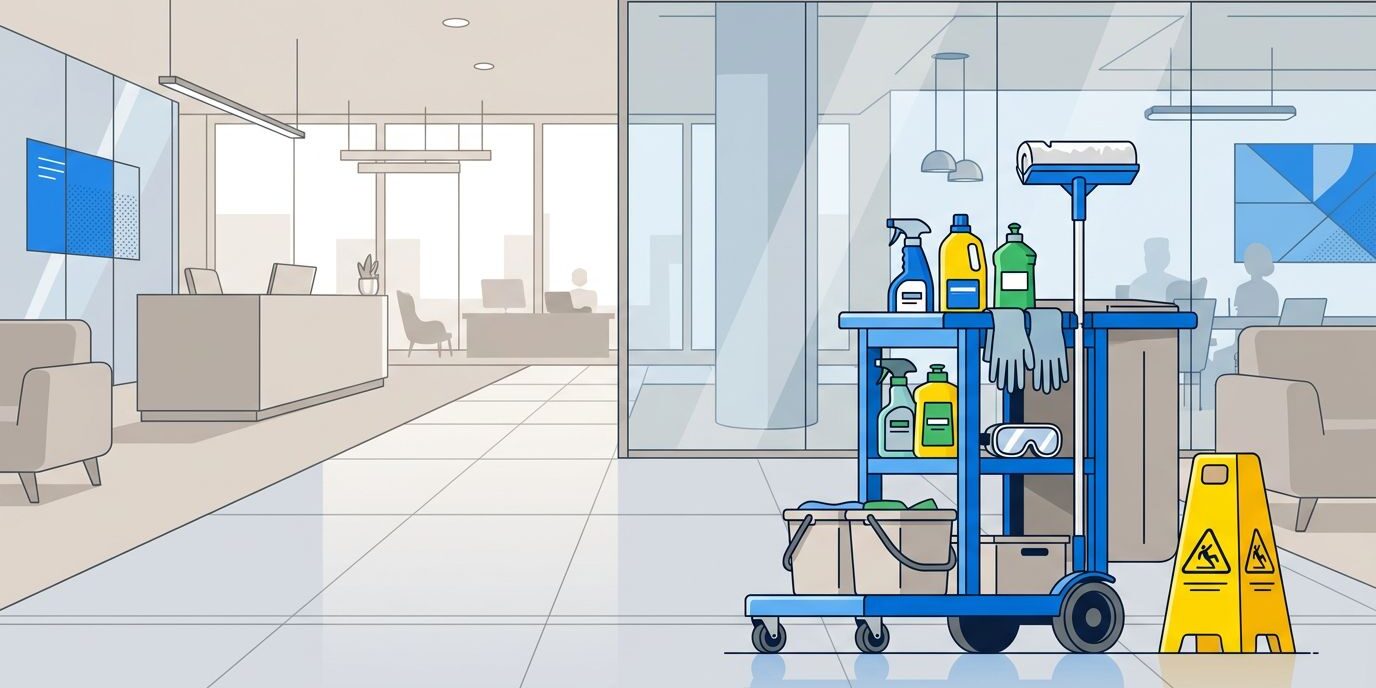
A wet floor, an unlabeled spray bottle, or a rushed climb can turn a routine cleaning shift into an avoidable disruption.
A strong commercial cleaning safety plan protects cleaning staff, employees, visitors, and the property itself. It also helps business owners maintain a clean, professional environment without creating unnecessary risks during the workday.
The best cleaning plan is practical. It matches the building, the schedule, the products, and the people who use the space every day.
Key Takeaways
- A commercial cleaning safety plan should reflect the building, its traffic patterns, cleaning tasks, products, equipment, and people who use the space.
- Identify changing hazards such as wet floors, blocked walkways, chemical exposure, damaged equipment, poor lighting, and high-traffic areas before each shift.
- Store and label chemicals correctly, keep SDS information available, follow dilution and ventilation instructions, and provide task-specific PPE and training.
- Protect people in occupied areas with wet floor signs, clear walking routes, prompt spill response, color-coded tools, and schedules that match building traffic.
- Use inspections, training records, incident reports, and corrective actions to keep the safety plan active and improve cleaning work over time.
Build a Cleaning Plan Around the Building
A written safety plan for commercial cleaning should reflect how your facility operates. A medical office, restaurant, school, retail store, and professional office each have different traffic patterns, surfaces, access rules, and health concerns.
OSHA identifies chemical exposure, slips, falls, ergonomic strain, and equipment hazards as common occupational safety concerns in its cleaning industry overview. Your plan should identify which of these risks apply to your workplace before the first shift begins.
Map the cleaning work by area
Walk through the property and divide it into practical zones. Include entrances, lobbies, restrooms, break rooms, offices, storage areas, stairwells, utility closets, and exterior walkways.
For each area, identify the cleaning tasks, approved products, required equipment, expected frequency, and possible hazards. A restroom may require gloves, color-coded tools, and careful floor-drying procedures. An entrance may need extra attention during Southwest Florida rainstorms, when moisture and tracked-in debris increase quickly.
The map becomes a working part of the cleaning plan and helps crews work consistently. It also gives managers a clear record of what should happen in every part of the building.
Assign clear safety responsibilities
Safety duties should never be vague. Facility management should know who reports a spill, who approves product changes, who has access to Safety Data Sheets, and who contacts the building after an incident.
We recommend naming one primary contact for the client and one for the cleaning provider. Both parties should understand emergency access procedures, alarm codes, key control, restricted areas, and after-hours communication.
A plan works best when every person knows what to do before a problem occurs.
Identify Hazards Before the Crew Starts
A good cleaning plan begins with an ongoing safety review. Conditions change when tenants move furniture, weather shifts, flooring ages, or new products enter the supply closet.
Before service begins, inspect the property for loose mats, uneven flooring, damaged cords, poor lighting, blocked exits, overloaded storage shelves, and wet areas. Look closely at places where employees and visitors walk during cleaning hours, since these conditions can contribute to workplace injuries.
Watch for conditions that change during the day
Occupied workplaces create moving hazards. A hallway that is empty at 6:00 p.m. may be crowded at 8:00 a.m. A break room may need cleaning after lunch, but it may also have employees carrying hot drinks and food through the area.
Cleaning teams should know when high-traffic areas are busiest. Schedule detailed floor work, carpet extraction, high dusting, and larger equipment use during quieter hours whenever possible.
Weather also deserves attention. Rain can make entry mats saturated and tile floors slippery. Outdoor walkways, lobby entrances, and glass doors may need extra inspections after storms.
Include special areas in the walkthrough
Some spaces need additional health and safety procedures. Medical and dental offices may have infection-control requirements. Restaurants may have grease, food safety, and kitchen access concerns. Schools and daycares may have children present during service hours, and a classroom cleaning checklist helps set clear standards for those rooms.
Document these areas separately in the cleaning plan. List access restrictions, approved products, personal protective equipment, and any special cleaning sequence. This prevents crews from making unsafe assumptions onsite.
Handle Cleaning Chemicals With Clear Controls
Cleaning chemicals can support a healthier environment when they are selected, stored, diluted, and used correctly. They can also irritate skin, eyes, and lungs when instructions are ignored.
Chemical handling starts with keeping every hazardous product in its original labeled container unless it is transferred to a properly labeled secondary container. Cleaning teams should never rely on memory to identify an unlabeled bottle.
Keep SDS information available to workers
The OSHA standard requires employers to communicate chemical hazards to exposed workers. OSHA’s Hazard Communication guidance for janitorial work explains the importance of giving cleaning staff access to labels and hazard information.
Safety Data Sheets, often called SDSs, should be easy to locate during every shift. They provide details about first aid, product hazards, protective equipment, storage, spill response, and exposure controls.
Keep an updated product inventory with the SDS file. When a product changes, update the cleaning plan and train the crew before it is used.
Dilute and ventilate according to the label
More product does not mean a cleaner surface. Overuse can leave residue, create strong odors, damage finishes, and increase chemical exposure.
Use measured dilution systems or clearly marked mixing bottles. Follow the manufacturer’s instructions for water temperature, dilution ratios, dwell time, and surface compatibility. Never mix cleaning products unless the label clearly allows it.
Ventilation requirements depend on the product. Review the chemical section of the cleaning plan before using a product in restrooms, storage rooms, small offices, or other limited-airflow spaces. OSHA notes that cleaning chemical precautions may include ventilation systems, personal protective equipment, gloves, or other controls.
Keep Floors Safe While People Are Present
Slip and fall accidents can affect employees, customers, visitors, and cleaning staff. They can also create costly interruptions for the business.
Floor safety starts with a cleaning plan. It should identify which surfaces dry quickly, which products leave residue, and which methods suit each surface. Tile, polished concrete, vinyl, entry mats, and carpeted transition areas all need different methods.

Photo by Daigoro Folz
Control walking routes during floor care
Use wet floor signs before mopping begins, not after a person enters the area. Place signs where people can see them from each approach. When possible, clean one side of a hallway at a time so a dry route remains open.
Keep cords, buckets, vacuum hoses, and carts out of walkways. Remove signs once the floor is dry, because abandoned signs can become visual clutter and lose their purpose.
A wet-floor sign supports safety only when people can also use a dry, clear route around the work.
Treat spills as urgent work
A spill in a lobby, restroom, break room, or entrance should receive immediate attention. The cleaner should block the area, use the correct cleanup procedure, and leave the surface dry before reopening it.
The same standard applies to leaks, tracked-in rainwater, and overflowing trash. Record repeated leaks and moisture patterns in the cleaning plan, especially when they happen repeatedly in the same location. Repeated moisture may point to a building maintenance concern rather than a cleaning issue alone.
Use Color-Coded Tools to Prevent Cross Contamination
Color-coded microfiber cloths, mop heads, and brushes help crews keep tools assigned to the right areas. Document those assignments in the cleaning plan. This keeps a restroom cloth from reaching a desk, break room counter, lobby surface, or glass.
The CDC’s cleaning equipment guidance notes that color coding can keep tools assigned to separate areas, including toilets and patient spaces. The same approach is helpful in offices, schools, clubs, and other shared facilities.
Give each color a clear job
Choose a color system that fits the property, then train every crew member to follow it. For example, one color may be assigned to restrooms, another to general office surfaces, another to break rooms, and another to glass.
The exact colors matter less than consistency. Post the color guide in supply closets and on cleaning carts. Launder reusable microfiber correctly after each shift, and replace worn tools that no longer clean effectively.
The color guide gives the cleaning plan a repeatable standard for onboarding and daily work. It protects surfaces, improves hygiene, and reduces confusion for new staff members.
Reduce Strain and Control High-Access Work
Many workplace injuries in commercial cleaning involve sprains, strains, and overexertion. Repetitive motions, heavy trash bags, full mop buckets, awkward lifting, and poor equipment setup can wear down a cleaning crew over time.
We recommend reviewing how workers move throughout the building against the cleaning plan, not only what they clean. A safer method often saves time as well.
Use tools that reduce physical strain
Choose ergonomic tools, adjustable handles, lightweight vacuums, wheeled carts, and other cleaning equipment matched to the task. Keep supply carts organized so employees are not carrying chemicals, liners, and tools across long hallways.
Train staff to use safe lifting techniques, including lifting with their legs, keeping loads close, and avoiding twists. Heavy loads should be split into smaller loads or handled with a cart. If an item is too heavy or unstable, two trained workers should handle it.
Short task rotation can also reduce repetitive strain during vacuuming, mopping, scrubbing, and high-touch disinfection.
Treat ladders as equipment, not shortcuts
Ladder safety means treating ladders as equipment, not shortcuts. Chairs, desks, rolling office furniture, and storage shelves are never safe substitutes for a ladder. Before high-access work begins, inspect the ladder for damage, confirm that the floor is level, and keep the area below clear.
OSHA’s general industry ladder standard includes requirements for ladder use and condition. Workers should face the ladder while climbing, maintain stable contact, and avoid overreaching.
For high dusting, interior glass, or elevated window work, choose the correct pole, ladder, lift, or other approved access equipment. Supervisors should record the need for different access equipment in the cleaning plan. If the job cannot be completed safely with available equipment, reschedule it with the right tools and trained personnel.
Train Crews for the Work They Actually Do
Safety training should match the commercial cleaning work and the assigned duties. A general orientation is useful, but it does not replace hands-on instruction for floor machines, chemical dilution, ladder use, infection-control procedures, or emergency response.
The cleaning plan should include training before a worker handles hazardous products or equipment. Refresher safety training helps prevent workplace injuries when products, procedures, or building conditions change.

Photo by Tima Miroshnichenko
Cover the details that affect each shift
Training should cover product labels, SDS access, PPE, chemical handling and dilution procedures, ergonomic tools, spill response, safe lifting, wet floor controls, equipment inspection, and incident reporting.
Workers also need to understand the property. Show them where emergency exits are located, which rooms are restricted, how to report a damaged surface, and who to call when an issue cannot wait.
OSHA’s cleaning industry safety and health resources support ongoing programs that identify hazards and improve health and safety practices over time.
Use short reminders to keep standards active
A five-minute pre-shift meeting provides a short review of the cleaning plan and can prevent missed steps. Discuss weather conditions, special events, service changes, new products, reported hazards, and high-traffic areas.
Supervisors should observe work periodically and correct unsafe methods right away. Training records should show the topic, date, trainer, and employees who attended. This creates accountability and helps managers identify when repeat training is needed.
Schedule Cleaning Around Occupied Areas
The safest cleaning plan is not always the fastest schedule. It should allow crews to complete their work without rushing around employees, visitors, deliveries, or active customers.
After-hours service may reduce foot traffic, but it also requires following clear safety protocols for access, lighting, alarms, keys, and emergency contacts. Day porter services may be appropriate for daytime restrooms, lobbies, and touchpoint cleaning, but crews need to work carefully around people.
Match cleaning tasks to building traffic
Schedule floor machine work, detailed restroom cleaning, carpet extraction, and larger equipment use during lower-traffic periods. Spot-cleaning and light maintenance can happen during the day when teams have a safe route and appropriate signage.
Give employees a way to report urgent concerns such as spills, broken dispensers, strong odors, or damaged flooring. The cleaning plan should distinguish urgent concerns from routine requests, with different response expectations.
Clear communication prevents minor issues from becoming safety problems.
Inspect Results and Correct Problems Quickly
A clean property is not measured by appearance alone. A crew can spend the expected number of hours onsite and still miss required tasks.
Use written checklists tied to the cleaning plan, supervisor inspections, and time-stamped records as part of a quality assurance process. Checklists confirm task completion. Visual inspections confirm the quality of that work. Together, they provide a second layer of quality assurance.
Measure completion separately from appearance
Task completion rate compares completed scheduled tasks with total scheduled tasks. A practical calculation is:
Completed scheduled tasks divided by total scheduled tasks, multiplied by 100.
Set clear standards for common areas. For example, restroom floors should be dry, dispensers should be stocked, and visible soil should be removed. Entry glass should be free of fingerprints and streaks at normal viewing distance. Walkways should not have loose debris or standing water.
When a task is missed, identify the reason. The cause may be training, access, staffing, supplies, equipment failure, or an unclear scope of work.
Close the loop on reported issues
A reliable correction process should follow the same steps every time:
- Record the issue, location, time, and safety concern.
- Compare the concern with the written cleaning agreement and cleaning plan.
- Assign the right worker, equipment, and supplies.
- Complete the correction and inspect the result.
- Document the follow-up and change the procedure if the issue keeps returning.
Track the first-time fix rate as well. This measures how often a reported issue is resolved during the first response. A low rate may point to unclear instructions, missing supplies, or poor communication.
Put Safety Duties Into the Cleaning Agreement
Your janitorial services agreement should support the cleaning plan, not sit separately from it. It should identify service areas, frequencies, cleaning products, supply responsibilities, equipment, access rules, and quality standards.
Facility management and the cleaning provider should agree on who provides PPE, wet floor signs, keys, alarm access, and emergency contacts. The agreement should cover accident, near-miss, spill, property damage, and recurring hazard reports, including workers compensation records. It should define quality assurance inspections and service standards.
OSHA’s cleaning industry standards resources can help business owners understand the safety topics that may apply to commercial cleaning operations.
We also recommend defining what counts as extra work. Document specialized cleaning tasks in the cleaning plan, along with their required controls. Carpet extraction, high dusting, interior glass, floor restoration, post-event cleanup, and water cleanup may require different equipment and time.
For a customized scope that fits your building, schedule, and safety needs, Get a FREE Quote Today.
Frequently Asked Questions
What should a commercial cleaning safety plan include?
It should identify building-specific hazards, cleaning tasks, approved products, equipment, PPE, access rules, emergency contacts, and reporting procedures. It should also assign clear responsibilities to facility management, supervisors, and cleaning staff.
How should cleaning chemicals be managed safely?
Keep products in their original labeled containers or properly labeled secondary containers, and make SDS information available during every shift. Follow the manufacturer’s dilution, ventilation, storage, and surface-compatibility instructions, and never mix products unless the label allows it.
How can cleaning teams prevent slips and falls in occupied workplaces?
Use wet floor signs before work begins, maintain a dry and clear route, and keep cords, carts, buckets, and hoses out of walkways. Treat spills, tracked-in rainwater, and leaks as urgent work, and remove signs when the floor is dry.
How often should cleaning staff receive safety training?
Workers should receive training before handling hazardous products or equipment and whenever procedures, products, or building conditions change. Short pre-shift reminders, periodic observations, and refresher training help keep safe methods active.
Who is responsible for maintaining the cleaning safety plan?
Facility management and the cleaning provider should share responsibility for keeping the plan accurate and following it during daily work. The cleaning agreement should define contacts, PPE and equipment duties, access procedures, incident reporting, inspections, and follow-up expectations.
A Safer Workplace Starts With Consistent Work
A clean workplace should also be a safe workplace. A documented cleaning plan, trained crews, proper products, dry floors, and clear follow-up records help protect everyone in the building.
The strongest commercial cleaning safety plan is not a binder left on a shelf. It is a living cleaning plan that guides every shift, every task, and every correction.