
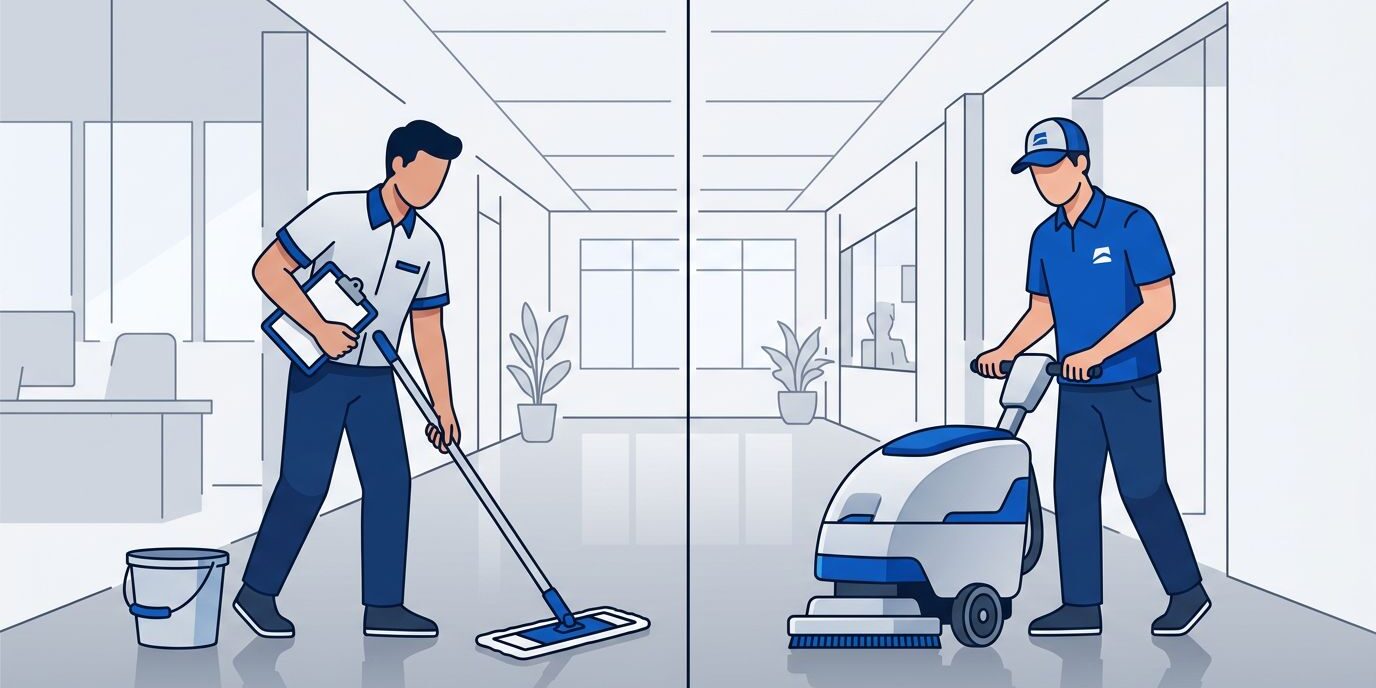
A clean office looks simple from the hallway, but keeping it that way is a complex task. When you are weighing in-house vs outsourced cleaning, you are not only picking who empties bins and sanitizes restrooms. You are choosing who hires, trains, covers staff absences, manages inventory, and owns the final result. For any facility manager, this decision involves navigating the intricate world of commercial cleaning services to ensure your space remains professional and safe.
That choice directly impacts your budget, the consistency of your maintenance standards, tenant satisfaction, and your own valuable time. Ultimately, the right answer depends less on abstract theory and more on the unique operational needs of your building.
Key Takeaways
- It is a management decision, not just a cleaning task: Choosing between in-house and outsourcing is fundamentally about who owns the operational systems, hiring, training, and accountability behind the work.
- Calculate the true cost of in-house: Relying on simple hourly wages is misleading. You must account for hidden overhead, including payroll taxes, equipment, insurance, and the management hours spent covering staff absences.
- Identify your operational capacity: If you lack a dedicated HR and facilities team to manage staff performance and quality standards, the administrative burden of in-house cleaning often outweighs the perceived control.
- Outsourcing provides scalability and risk mitigation: Third-party vendors excel at maintaining consistent standards through labor depth, as they manage employee turnover and backfill absences, shielding your team from daily logistical headaches.
- The hybrid model is a viable alternative: Many facilities benefit from keeping a day porter in-house for high-touch tasks while outsourcing intensive, after-hours cleaning to a professional service provider.
The real decision is who manages the cleaning operation
Plenty of teams frame this as a simple cleaning question. It is not. It is a management question.
An in-house model means the cleaning staff is on your payroll. You recruit them, train them, schedule them, supervise them, and replace them when someone quits. An outsourced model means a third-party vendor handles most of that work under a service agreement for professional janitorial services.
That sounds obvious, but it is where people get tripped up. They compare hourly wages to a contract price and stop there. That misses the larger issue. Cleaning quality usually follows the strength of the system behind it.
If your office team is chasing callouts, buying paper goods, and checking supply closets, you are already managing a significant administrative burden instead of focusing on your core business.
There is another distinction that matters. Asking admins or maintenance staff to pitch in is not the same as building an in-house program. It is usually a sign that no one truly owns the work. The result is predictable: missed details, uneven standards, and frustrated employees.
In a commercial facility, consistency matters more than occasional effort. Lobbies, conference rooms, elevators, washrooms, and break areas do not stay presentable because someone remembers to wipe a surface. They stay presentable because the work is assigned, inspected, and repeated.
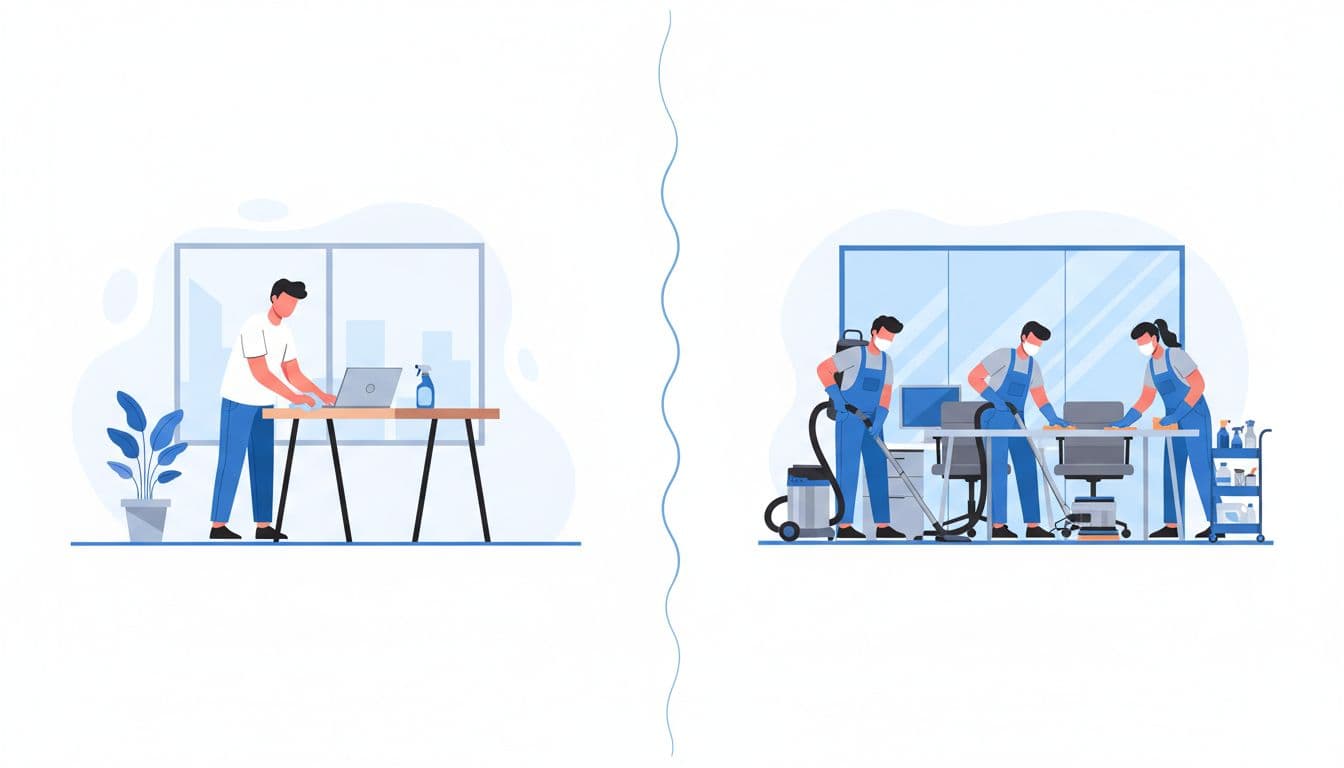
Once you look at the choice this way, the tradeoff gets clearer. In-house gives you direct control. Outsourcing gives you a ready-made operating system. The better option depends on whether you want to build that system yourself.
Cost looks different once you count the hidden work
The easiest mistake in this decision is treating payroll as the full cost of an in-house team. It is not even close.
A direct employee’s wage is only the starting point. You also have payroll taxes, workers compensation, liability insurance, paid time off, hiring time, training time, uniforms, equipment, chemicals, storage, and supervision. If someone calls out sick, you still need the building cleaned. That means overtime, reassignment, or a service gap.
A vendor contract can look higher on paper because those costs are bundled. That is why apples-to-apples comparisons matter. A useful breakdown from Hillyard on insourcing or outsourcing a cleaning program makes the same point: labor is only one part of the total picture when calculating your operational costs.
This quick comparison helps put the choice in plain view.
| Factor | In-house team | Outsourced vendor |
|---|---|---|
| Hiring and onboarding | Your responsibility | Usually handled by vendor |
| Cleaning supplies and cleaning equipment | Bought and managed internally | Often included or coordinated |
| Coverage for absences | Your team must solve it | Vendor typically backfills |
| Daily oversight | Internal managers handle it | Shared between you and vendor |
| Specialized floor care | May need extra training or contractors | Often available within contract or add-on services |
The takeaway is simple. The lower hourly number does not always mean the lower operating cost.
There is also the cost of distraction. If your office manager spends five hours a week fixing cleaning issues, that is real overhead. Another comparison from Cleared Direct’s commercial cleaning guide highlights the same tension between direct control and the labor needed to maintain it.
None of this means outsourcing is always cheaper. In some buildings, especially smaller ones with stable needs, keeping cleaning in-house can provide genuine cost savings. But if you do not count management time and service interruptions, the math will lie to you.
When an in-house cleaning team can be the better fit
Outsourcing is not the automatic winner. Some office buildings are better served by internal staff, and the reasons are practical.
First, direct control matters in certain environments. If your building has strict access rules, executive areas, or highly sensitive workspaces, a small trusted in-house team can be easier to manage. You know who has keys, who entered which suite, and who handled which issue, which is vital for maintaining safety regulations.
Second, some properties need constant daytime presence more than after-hours production cleaning. A corporate headquarters or a busy multi-tenant commercial facility may need a porter who knows the people, the traffic patterns, and the problem spots. That kind of familiarity has value. The same person notices the restroom cleaning needs when a dispenser runs out of supplies every afternoon. The same person sees coffee spills before clients do and can even monitor factors like indoor air quality throughout the day.

Photo by Tima Miroshnichenko
In-house can also work when your company already has the structure to support it. Large organizations with strong HR, procurement, training, and facilities leadership may have the bandwidth to run cleaning well. In that case, the extra oversight is not a burden; it is simply part of the machine.
Still, that setup only works when standards are documented and enforced. A familiar face does not replace a real process. If you go in-house, write scopes, checklists, inspection routines, and backup coverage plans. Otherwise, you are not building a team. You are building dependence on a few people.
Why outsourced commercial cleaning often wins in office buildings
For many office buildings, outsourced commercial cleaning works better because it solves the hardest part: reliability at scale.
A good vendor brings labor depth. If one cleaner is out, someone else steps in. If your occupancy changes, service scalability allows your requirements to expand or shrink without a full hiring cycle. If you need deep cleaning, floor maintenance, post-construction cleanup, or extra disinfection, those services are already within reach.
That matters more than people admit. Office cleaning is repetitive, physical work with steady turnover across the labor market. When you keep it in-house, every resignation lands on your desk. When you outsource, the risk of high employee turnover shifts entirely to the vendor.
There is also a supervision advantage. A solid contractor does not only send workers. They send a system, route planning, quality checks, supply management, and account oversight. If you are managing a property portfolio, that can be a major relief.
The best outsourced arrangements also provide cleaner accountability. The scope is written, frequencies are clear, and your service level agreements ensure that deficiencies are documented against the contract. You are not trying to correct performance through casual hallway conversations.
That said, outsourcing only works if the vendor is the right fit. A cheap contract with vague expectations is a slow-motion problem. You want clear task lists, communication rules, response times, and a point of contact with authority to fix issues.
Some buildings land in the middle, and that is fine. A hybrid model can work well, especially when you keep a daytime porter in-house and outsource nightly cleaning. You hold onto building familiarity while offloading the heavier staffing burden.
How to choose without guessing
The smartest way to compare in-house and outsourced office cleaning is to test the decision against your building’s real needs, not a generic template.
Start with the building itself. How many occupants are there on a typical day? Identify which areas get dirty fastest and require higher hygiene standards to maintain a professional environment. Do you need day porter coverage, after-hours service, or both? A quiet two-floor office and a busy multi-tenant property should not use the same cleaning model.
Then look at your internal capacity. Who will own hiring, scheduling, training, safety, and rigorous quality control if you keep cleaning in-house? If the honest answer is whoever has time, that is your answer.
A short evaluation process usually tells the story:
- Document the scope by area, frequency, and specific requirements such as green cleaning preferences.
- Price the full in-house cost, not only wages.
- Compare it to proposals from a professional cleaning company with a matching scope.
- Check how each option handles absences, complaints, and special projects.
- Run a 60 to 90-day pilot if the decision is close.
Pay attention to response time, not promises. Anyone can say they care about quality. The better question is what happens when a restroom is missed, a spill sits too long, or a tenant complains at 7:30 a.m.
If you are at the point where numbers, staffing, and service expectations need to be nailed down, Get a FREE Quote Today and compare it against your true internal cost. That gives you something better than a guess.
Frequently Asked Questions
Is it always cheaper to manage cleaning in-house?
No, it is often more expensive once you calculate the total cost of ownership. Beyond payroll, you must account for equipment maintenance, insurance, chemicals, and the time your management team spends on hiring and supervision.
How do I know if my building is a good candidate for in-house cleaning?
In-house cleaning works best if your facility requires specific security clearances or constant daytime presence from a porter who is highly familiar with your tenants. It is only successful if you have the internal structure to enforce strict quality control and training protocols.
What are the main benefits of outsourcing cleaning services?
Outsourcing shifts the burden of recruitment, training, and staff absences to the vendor. You gain access to a ready-made operating system that includes equipment, supply management, and accountability measures that ensure consistent service levels.
Can I use a hybrid model for office cleaning?
Yes, a hybrid model is an effective way to balance familiarity with efficiency. Many buildings keep a dedicated in-house day porter for immediate, high-touch needs while contracting an outside company to handle the heavier, nightly janitorial requirements.
Conclusion
A clean office does not come from good intentions. It comes from a cleaning model your team can support week after week.
Deciding between in-house vs outsourced cleaning requires an honest look at your internal resources. If you have the staff, structure, and need for direct control, an internal team can work well. If you need dependable coverage, easier scaling, and less operational drag, contract cleaning often makes more sense for your facility. The best choice is the one that gives your building consistent results without turning maintenance into a massive drain on your valuable management time.