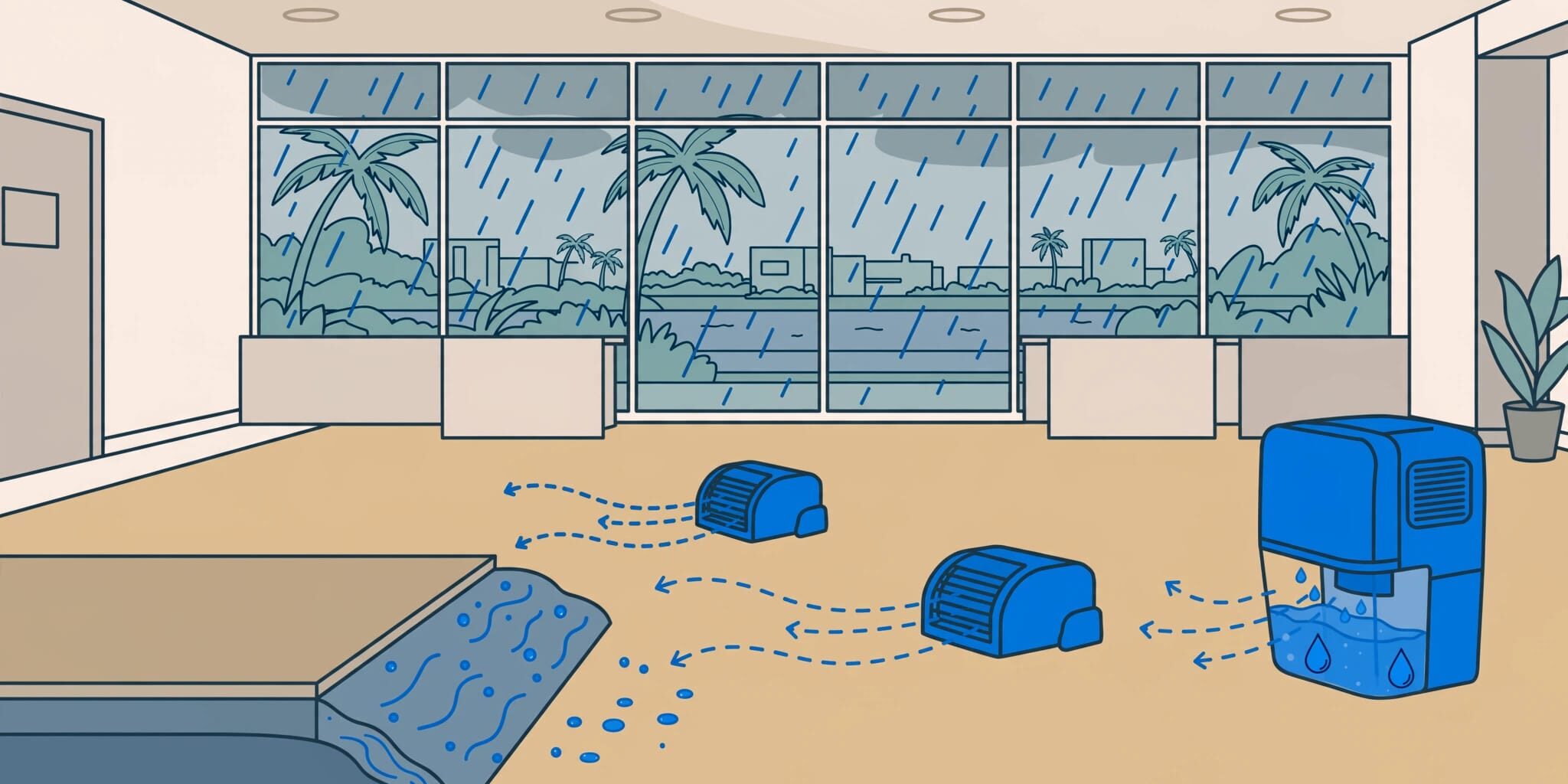
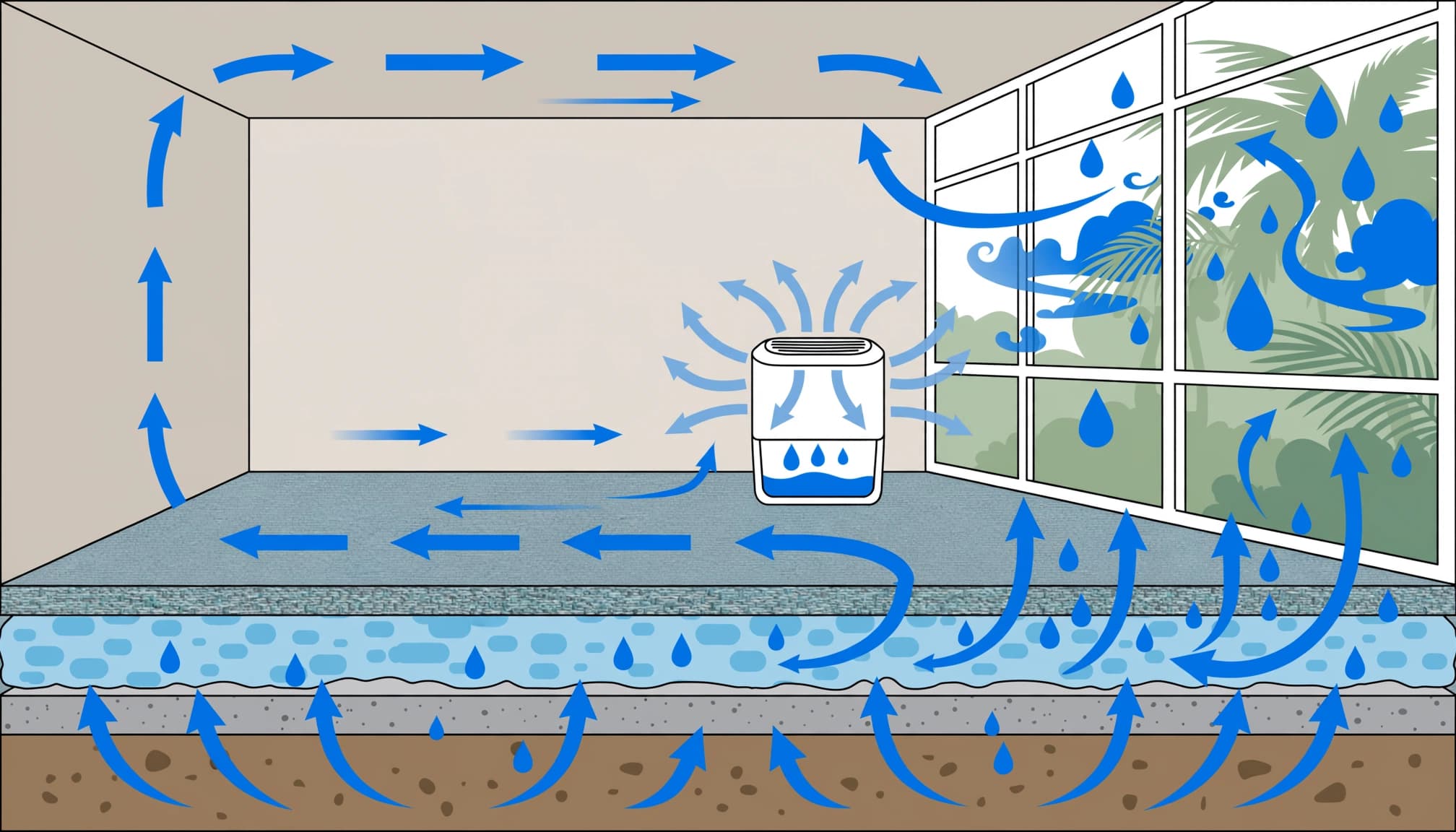
Commercial carpet drying takes longer in Southwest Florida because humid air slows evaporation, and carpet backing and padding can hold hidden moisture. Strong airflow helps, but moisture removal matters just as much.
For your business, slow drying can delay reopening, create odors, and leave flooring vulnerable to mold. We recommend planning drying around your carpet, cleaning method, and indoor conditions, starting with the reasons moisture stays behind.
Key Takeaways
- Humidity, restricted air movement, and moisture beneath the carpet can extend drying beyond the expected schedule.
- Air movers speed evaporation, while dehumidifiers remove the moisture released into the room.
- A dry surface doesn’t prove the backing, padding, or floor underneath is ready for furniture and normal traffic.
Why Southwest Florida Slows Carpet Drying
Humid air slows evaporation
Carpet releases moisture more slowly when the surrounding air is already humid. The Florida Climate Center’s humidity explanation describes relative humidity as moisture in the air compared with its capacity at that temperature.
This matters in Fort Myers, Cape Coral, and nearby communities, where humid outdoor air can enter through frequently opened doors. Rainy conditions and reduced overnight air-conditioning can further limit drying.
Warm weather alone doesn’t guarantee a dry carpet. The room also needs effective moisture removal.
Backing and padding retain moisture
Low-pile, glue-down commercial carpet generally holds less water than thick carpet installed over absorbent cushion. However, its backing and the surface underneath still need attention.
Dense carpet fibers, soaked padding, and excess cleaning water can extend drying. Desks, filing cabinets, and enclosed corners also restrict airflow.
We recommend including drying expectations in your office carpet cleaning and maintenance plan, rather than treating drying as an automatic result.
How Long Commercial Carpet Drying Takes
The cleaning method determines how much water must leave the carpet and affects drying time. These benchmarks describe different processes, so fast-drying claims aren’t interchangeable promises.
| Cleaning method | Drying benchmark | Important limitation |
|---|---|---|
| Hot water extraction, often called steam cleaning | Can take 12 to 24 hours | Humidity, excess water, and padding can extend drying |
| Oxi Fresh’s low-moisture process | About one hour, according to the company | A method-specific claim, not a standard for every low-moisture service |
| Tennant ReadySpace | Equipment literature advertises less than 30 minutes | Uses less water and differs from deep restorative cleaning |
Tennant’s ReadySpace technology is designed for rapid-drying carpet maintenance. That short turnaround doesn’t apply to heavily soaked carpet after deep restorative cleaning or flooding.
Water volume matters as much as carpet style. Routine wet extraction that lightly wets the pile differs from a leak that saturates the backing and cushion.
We recommend reserving an overnight access window for this water-intensive method when business operations allow it. Reopening should still depend on actual conditions, not the calendar alone.
Choose the Right Carpet Dryer
Air movers, also called carpet dryers or carpet blowers, are compact fans that move high volumes of air across wet carpet. They accelerate evaporation but don’t collect the resulting water vapor.
Commercial listings include approximately 925 to 3,200 CFM, meaning cubic feet per minute, and motors rated around 1/4 to 1/2 HP.
These common designs suit different spaces.
| Air mover type | Suitable application |
|---|---|
| Axial | Broad, open areas needing high-volume airflow |
| Centrifugal air mover | Concentrated airflow along edges, tight corners, and dense carpet areas |
| Low-profile | Restricted spaces beneath suitable furniture and low clearances |
Many commercial models are stackable and offer 3 speeds. Some include a three-hour timer or an adjustable zero-to-three-hour timer.
Listed equipment prices range from about $109 for a mini air mover to approximately $2,520 for a specialized wall-and-floor drying system. Many standard commercial units fall around $230 to $450.
A higher CFM rating doesn’t establish a reliable square-foot coverage number. Outlet design, room layout, furniture, and moisture levels affect performance. Motor horsepower alone also doesn’t tell you how effectively air reaches the carpet.
We recommend selecting equipment for the layout and moisture conditions, rather than buying the largest fan available.
Set Up Airflow Without Adding More Moisture
Direct air across the carpet
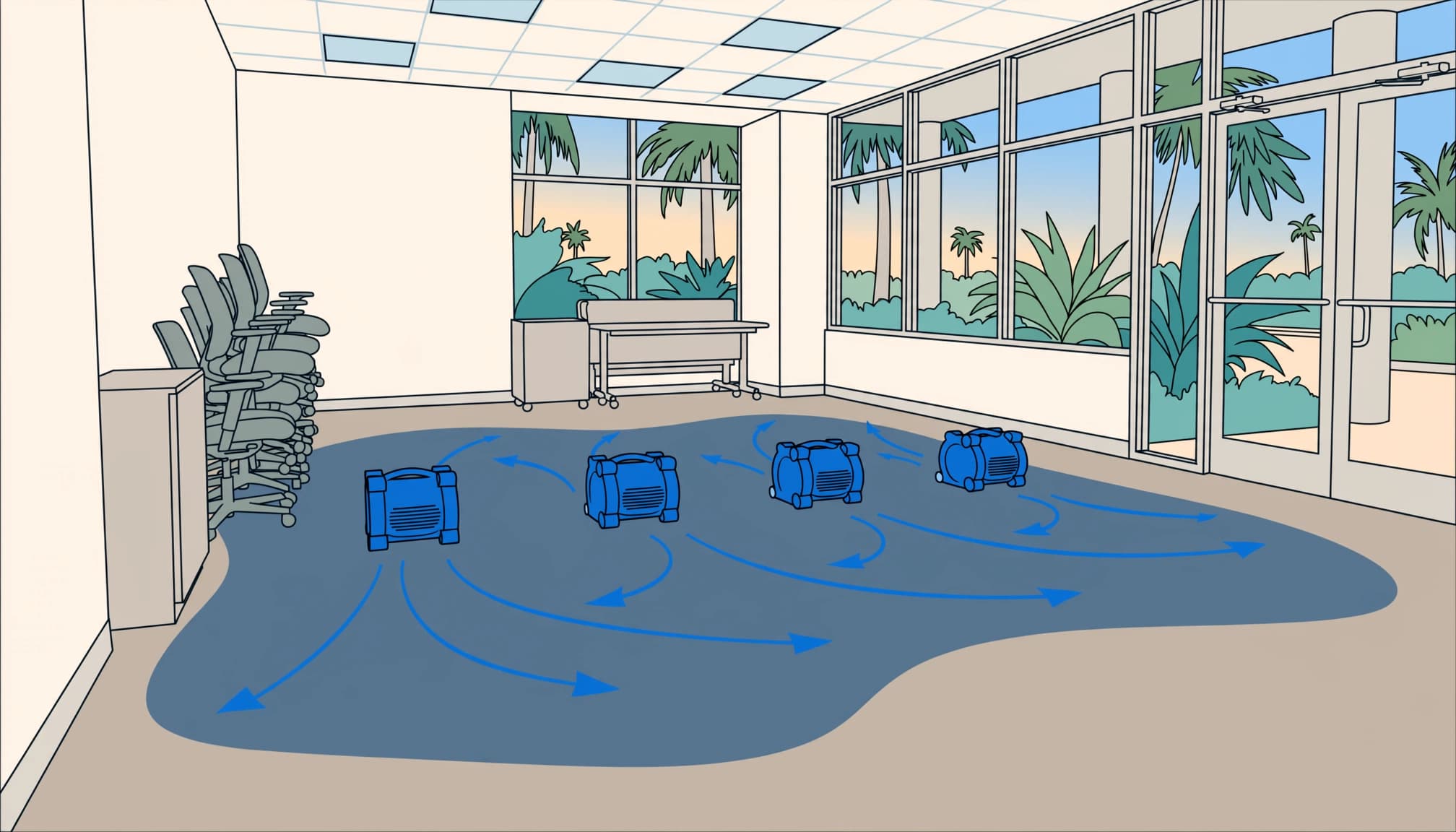
Angle air movers so air moves across the carpet rather than straight down. Several units can create crossflow around partitions and furniture, provided their air streams don’t oppose each other.
Keep outlets clear and give enclosed offices their own air route. A powerful fan in a hallway may do little for carpet behind a closed conference-room door.
There isn’t a dependable fan-per-room formula for every office. Placement should follow the wet areas, obstructions, and drying progress.
Combine circulation with moisture removal
The EPA’s carpet and backing drying guidance emphasizes water removal and drying the materials beneath the visible surface.
Air movers work best when dehumidification or suitable ventilation removes evaporated moisture. Running fans in a sealed room without either can leave increasingly humid air circulating.
Open windows only when outdoor air is drier than indoor air. During humid Southwest Florida weather, closed windows with air-conditioning and dehumidification often provide better control.
Ceiling fans can support circulation. Attic fans don’t replace moisture removal inside an occupied office.
Protect Flooring and Electrical Safety
Avoid unsuitable carpet and floor conditions
We don’t recommend directing forceful air movement at old, fragile, or deteriorating carpet without professional assessment. Loose fibers, damaged backing, and separating seams need particular care.
Don’t dry an area rug over wood flooring without suitable separation and protection. Moisture can remain beneath the rug and damage the wood.
Visible mold, sewage, or contaminated floodwater requires qualified flood restoration support. Ordinary carpet cleaning and unrestricted fan use aren’t appropriate substitutes.
Plan electrical loads before starting
A heated carpet extractor and several dryers can overload a circuit. Trusted Clean’s heated extractor package includes a carpet extractor with two 50-foot power cords intended for separate circuits.
Separate outlets aren’t necessarily separate circuits. Use equipment within its labeled electrical limits, with manufacturer-approved surge protection where specified and GFCI protection where required. A surge protector doesn’t prevent circuit overload.
Multiple fans may run overnight after evening jobs, but cords, exits, and equipment require a safe setup. Keep connections dry, avoid overloaded power strips, and follow operating instructions. A three-hour timer won’t provide all-night drying unless its settings permit continuous operation.
Confirm Dryness Before Reopening
Surface dryness isn’t proof of complete drying. In one reported basement-flood example, two centrifugal air movers ran for 48 hours even though the carpet felt dry after 24 hours.
A technician can use an appropriate moisture meter to assess affected materials and compare readings with an unaffected dry area. Readings should account for the material and instrument, rather than relying on one universal percentage.
After water damage, documented moisture readings and updated moisture mapping provide a stronger basis for reopening.
The EPA’s mold and moisture guidance recommends drying wet materials within 24 to 48 hours to reduce mold risk. This is a response window, not a guarantee that mold cannot develop.
Don’t return furniture until the carpet surface and backing are adequately dry. Keep access restricted where cords, damp flooring, or cleaning equipment create hazards.
Prevent Recurring Odors and Slow Drying
Leftover moisture can contribute to musty odors and mould (called mold in U.S. usage) growth in padding or nearby materials. Damp carpet also collects tracked-in soil, while cleaning residue can attract fresh dirt.
We recommend proper rinsing, thorough extraction, and controlled drying instead of fragrance products that cover the smell. If odors persist after drying, a commercial carpet cleaner can assess wet padding, an unresolved leak, or another hidden source.
A spill, plumbing problem, air-conditioning leak, or storm-related intrusion needs prompt attention. Drying equipment cannot correct an active water source.
These conditions also affect office indoor air quality. Routine vacuuming removes loose particles, but it doesn’t replace periodic deep-water cleaning or moisture repairs.
A carpet cleaning package should include a written scope covering the method, furniture movement, drying equipment, access restrictions, and reopening instructions. Coordinate ventilation needs with building maintenance; cleaning crews shouldn’t open or service internal HVAC components.
Frequently Asked Questions
What is the quickest way to dry carpet after cleaning?
Remove as much water as possible through proper water removal, then combine directed airflow with moisture removal. In humid conditions, an air mover and dehumidifier usually provide better control than a fan beside an open window.
Can a business rent a carpet dryer?
Yes. Equipment-rental businesses offer air movers, and some also rent dehumidifiers. Rental equipment suits temporary needs, but extensive saturation or contaminated water requires professional restoration rather than an equipment-only approach. No single daily rental rate applies across Southwest Florida.
What should happen if carpet remains wet after 24 hours?
Arrange a prompt moisture assessment, especially if padding is present or odors develop. The response may require additional extraction, dehumidification, or investigation beneath the carpet. Don’t wait for visible mold or assume more fan time will resolve every cause.
Plan for a Clean, Dry Workplace
Reliable commercial carpet drying depends on water removal, controlled humidity, and air movement that reaches the affected areas. Complete drying protects your flooring and supports a cleaner, more comfortable workplace.
We provide commercial carpet cleaning and office cleaning throughout Southwest Florida. Contact us by phone or email to discuss your building’s cleaning needs and Get a FREE Quote Today.